My grandad Harry grew up in Attercliffe during the 1930s. Now, Harry was a man whose stories occasionally required a degree of interpretation.
According to him, the scar on his leg came from wrestling a lion. On another occasion he claimed to have turned a crocodile inside out by putting his hand down its throat, grabbing its tail and pulling. Whether either of those tales contained even the smallest grain of truth remains a matter for debate.
Yet amongst the lions, crocodiles and other improbable adventures was a story that always intrigued me. Harry swore that, when he was a boy, there was a woman in Attercliffe who owned a cat with wings.
Unlike the lion, he only mentioned it once and never embellished the tale. Unlike the crocodile, he never seemed to be telling it for effect. It was simply one of those odd facts he carried with him from childhood, offered matter-of-factly, as though everybody knew about the winged cat.
Years later, while researching Sheffield folklore and forgotten mysteries, I discovered that Harry may not have been spinning a yarn after all.
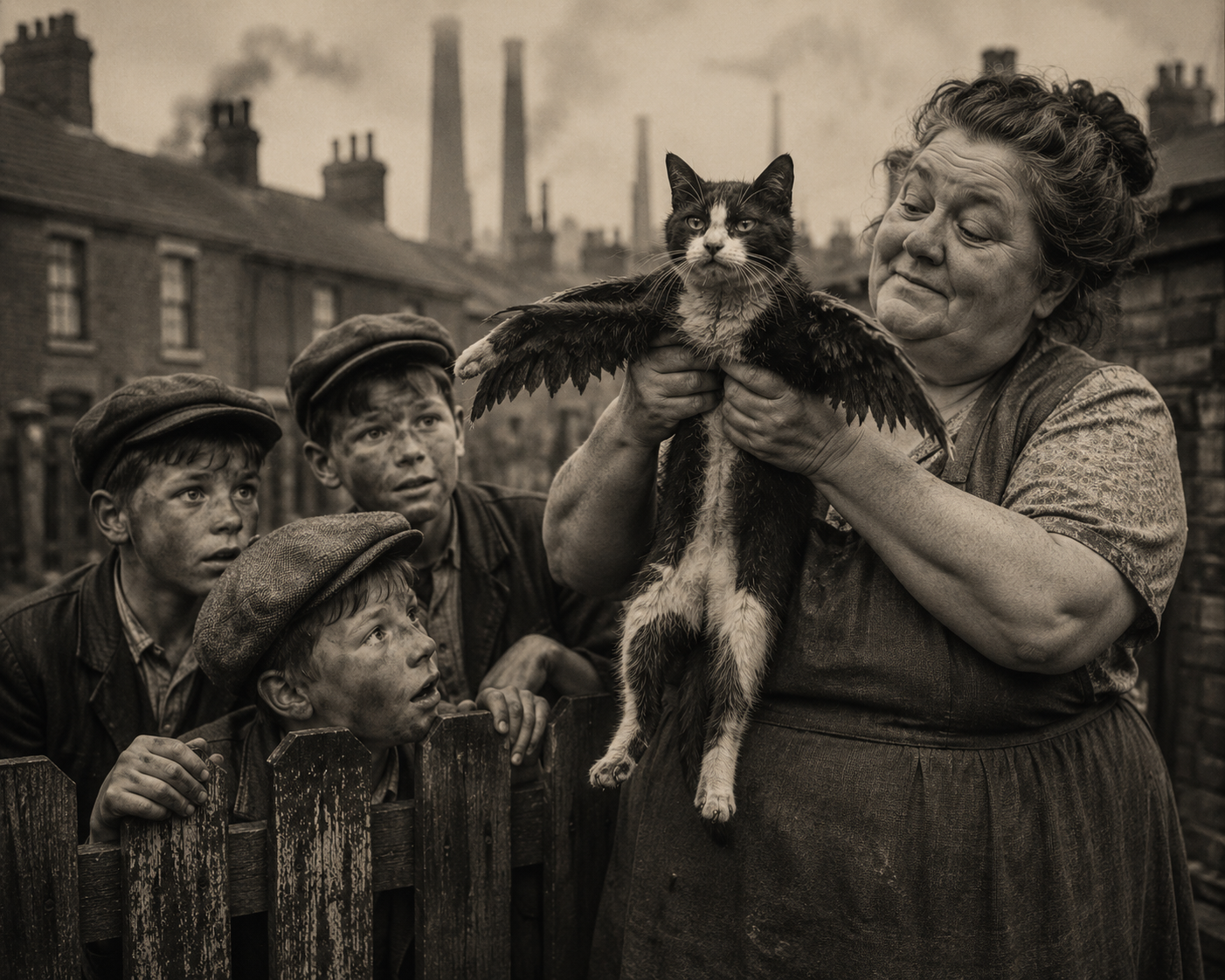
Because in the late 1930s, newspapers across Britain carried reports of a remarkable animal from Attercliffe. A black-and-white cat named Sally.
A cat that appeared to have wings.
Pull up a chair…
Now, there are certain stories that seem destined to remain trapped between fact and folklore. They appear briefly in newspapers, spark a flurry of excitement, and then vanish into the shadows, leaving behind only questions and this is such tale. It emerged from the smoky heart of Sheffield in the late 1930s. And before anyone begins muttering about escaped parrots, overactive journalists, or the effects of strong Yorkshire ale, it should be said that the story was reported as genuine.
Contemporary newspapers carried accounts of a black-and-white cat named Sally, owned by a Sheffield woman living in Attercliffe. According to reports, the animal possessed wing-like growths extending from its shoulders, giving it a wingspan of approximately two feet. The claim seems extraordinary. The photographs, grainy though they were, appeared convincing, and Sheffield was captivated.
At the time, Attercliffe was a very different place from the district we know today. The air was thick with coal smoke and the glow of steel furnaces. Shift workers poured from foundries at dawn and dusk. Rows of terraced houses stood beneath skies stained orange by industry. It was a city of hard labour and practical people. Yet it was also a city rich in folklore.
Stories of ghosts, black dogs, haunted pubs and uncanny creatures travelled quickly through Sheffield’s streets. The old traditions had not disappeared simply because blast furnaces had arrived. They merely adapted. So when word spread that a local cat had grown wings, many residents were willing to entertain the possibility that something unusual was afoot. The animal became known as “The Winged Cat of Sheffield.”
According to newspaper accounts, Sally’s wings were not capable of true flight. Nobody claimed she was soaring over the rooftops of Attercliffe like some feline angel. Instead, witnesses reported that the appendages appeared to assist her leaps and balance. She could supposedly clear fences and walls that other cats struggled to negotiate. Whether this was genuine observation or the inevitable exaggeration that accompanies local legend is impossible to determine, but what is certain is that the story gained significant attention.
So much attention, in fact, that Sally was reportedly acquired by a museum of curiosities in Blackpool.
And there the trail largely goes cold. No scientific examination survives. No definitive explanation was recorded. No final answer was ever reached. Like so many mysteries, the Winged Cat simply disappeared from the historical record.
Of course, modern veterinary science offers several possible explanations.The most common explanation for so-called winged cats is severe fur matting. In long-haired animals, neglected coats can form dense masses that hang from the shoulders and back, creating structures that resemble wings. Another possibility involves a rare skin condition known as cutaneous asthenia, which can produce loose folds of skin that hang from the body. More unusual cases have involved vestigial limbs or congenital deformities that create the appearance of additional appendages.
In most instances, a scientific explanation eventually emerges. But as we have discovered many times, folklore has never been particularly interested in scientific explanations. Folklore asks different questions. Why did the story capture people’s imaginations? Why did it endure? Why are we still talking about it nearly ninety years later?
Maybe because the image itself is just so compelling. A winged cat feels like something that ought to exist in mythology.
Cats already occupy a curious position in British folklore. They move silently through darkness. They see what humans cannot. They are associated with witches, fairies, spirits and the Otherworld. Across Britain, black cats have been considered both lucky and unlucky depending on where you happen to be standing. In Yorkshire, tales of spectral felines have appeared for centuries – Sheffield itself possesses a long tradition of strange animal stories. Among the most intriguing is the legend of the enormous black cat said to haunt Hell Mary Hill.
According to local tradition, the creature guards hidden treasure buried somewhere beneath the ground. Witnesses described a beast far larger than any ordinary cat, appearing suddenly before vanishing just as quickly. Was it a ghost? A guardian spirit? Or simply a story told around fires on dark winter evenings? Nobody knows.
But it demonstrates something important – Yorkshire has always had room for strange cats. Maybe that is why Sally found such a receptive audience. Maybe the people of Sheffield recognised something familiar in the story – not because they genuinely believed a cat had evolved wings overnight. But because the tale felt right. It belonged. It fitted naturally into a landscape already populated by phantom hounds, treasure guardians and things glimpsed at the edge of vision.
The 1930s were difficult years. Industry was changing. Economic uncertainty lingered. Europe drifted toward war. At times like these, stories matter. A winged cat offered wonder. A momentary escape. Proof, however fleeting, that the world might still contain mysteries.
And, to me at least, that is the true value of tales like Sally’s.
Whether the wings were caused by fur, skin, mutation or something far stranger matters less than the fact that the story survived. Nearly a century later, we still find ourselves looking over our shoulders and wondering.
Was Sally simply an unusual cat? A clever newspaper sensation? A misunderstood medical curiosity? Or was there genuinely something extraordinary prowling the back alleys of Attercliffe? We’ll probably never know.
Did Harry really remember Sally? I have no way of knowing that either. Childhood memories have a habit of blending fact, folklore and family legend into something entirely their own.
Yet of all the extraordinary tales he told me over the years, the winged cat of Attercliffe turned out to be the one supported by newspaper reports and historical records. The lion remains unverified. The crocodile seems unlikely… (So far, at least)
But the winged cat?
Well, perhaps Grandad Harry was right after all.
Sources:
Harry Mason
Contemporary newspaper reports from 1937–38
historical accounts of Sally the Winged Cat
Sheffield folklore traditions relating to uncanny animals and treasure-guarding black cats.