Take a walk through the British countryside and you’ll find them everywhere.
The landscape changes but the stories remain the same. A solitary hawthorn standing in the middle of a field. Most of us pass them by without a second thought, but our ancestors never did. A grassy mound no farmer seems willing to plough. A ribbon of mist drifting across a meadow on an otherwise still evening. An old stone bridge where people once paused to leave a coin. The crossroads where one path became another. Springs bubbling from the hillside. Ancient burial mounds whose true origins had long been forgotten. Thorn trees growing alone in open fields. Bridges spanning dark water. The hedgerow between pasture and woodland. The edges. The boundaries – the liminal places, folklorists call them. Places that belong to neither one thing nor another. To modern eyes they’re simply field boundaries, but many of Britain’s hedges are centuries old. Some predate the enclosures. Others trace medieval parish boundaries or forgotten drove roads. They became living borders between safety and uncertainty, cultivation and wilderness, the known world and whatever lay beyond. Cross one and the rules might change.
Long before Britain became a nation of roads, railways and housing estates, the countryside was regarded as a place shared with other beings. Some where thought to be helpful, others dangerous. Some might bless a household with good fortune, while others could lead a traveller hopelessly astray. They were neither angels nor devils, and they certainly not the tiny, glitter-winged creatures of Victorian story books. They belonged to something much older.
They were the Fair Folk.
The word ‘fairy’ can be misleading. It conjures up images of children’s tales and animated films, but Britain’s older folklore paints a far stranger picture. Depending on where you lived they might be called the Good Folk, the Good Neighbours, the Fair Family, the Hidden people or simply ‘Them’. In many communities, people avoided naming them altogether because naming them directly was thought to invite unwanted attention. Whether anyone truly believed such caution mattered is almost irrelevant. The fact that generations of sensible farmers, fishermen, shepherds and labourers repeated the same custom tells us something important. These stories weren’t entertainment. They were warnings.
In the Highlands, tales were told of the ‘Sith’, who dwelt within green hills that appeared ordinary by day but concealed magnificent halls beneath the earth. In Cornwall, piskies were said to delight in leading travellers astray across the moors, while the fearsome spriggans guarded ancient barrows and standing stones. Along the Welsh borders, the Tylwyth Teg danced beneath the moon, and in the Isle of Man, many people still prefer to refer to fairies as ‘Themselves’ or ‘The Little People’ rather than risk causing offence.
The idea appears again and again in British folklore. A traveller hears beautiful music drifting from a nearby hill. Someone follows the dancing lights through the trees and discovers that what felt like a single evening has become seven years. A midwife is summoned to assist at a mysterious birth only to discover that her patient isn’t quite human. A shepherd returns to find his herd exactly as he left it, yet everyone he knows has grown old. Such stories exist from Scotland to Cornwall, often separated by hundreds of miles yet sharing very similar themes. Time slips, hidden feasts, forbidden gifts and warnings ignored.
Of course, we can dismiss them as superstition and active imaginations, but folklore often tells us more about people than it does about the supernatural. These tales taught respect for dangerous landscapes, explained strange disappearances and reminded communities that arrogance rarely ended well. They encouraged travellers to stay on the known roads, warned children away from rivers at dusk and reinforced the idea that the world was larger and stranger than any one person can understand long before warning signs and the terrifying public information films of the nineteen seventies (whatever happened to them, eh?). Even so, some of the customs lingered well into living memory. Milk might be left outside on certain nights. Bread is shared instead of wasted. A lone hawthorn or ancient mound might be left standing when the surrounding field is cleared. Builders might occasionally alter plans rather than move trees or disturb old ground.
To outsiders these habits might seem quaint or superstitious. To those who inherited them, they were simply common sense. Why risk offending something that you can’t explain? One of the most intriguing aspects of fairy belief is that it rarely demands absolute conviction. People can laugh about such stories in daylight and still avoid cutting a hawthorn down. they can insist they don’t believe in fairies while quietly taking off their hat when they pass a fairy hill. Folklore often lives quite happily beside scepticism. That’s why so many traditions and customs survived until now. They weren’t rigid religious beliefs. They were habits of respect passed down from one generation to the next.
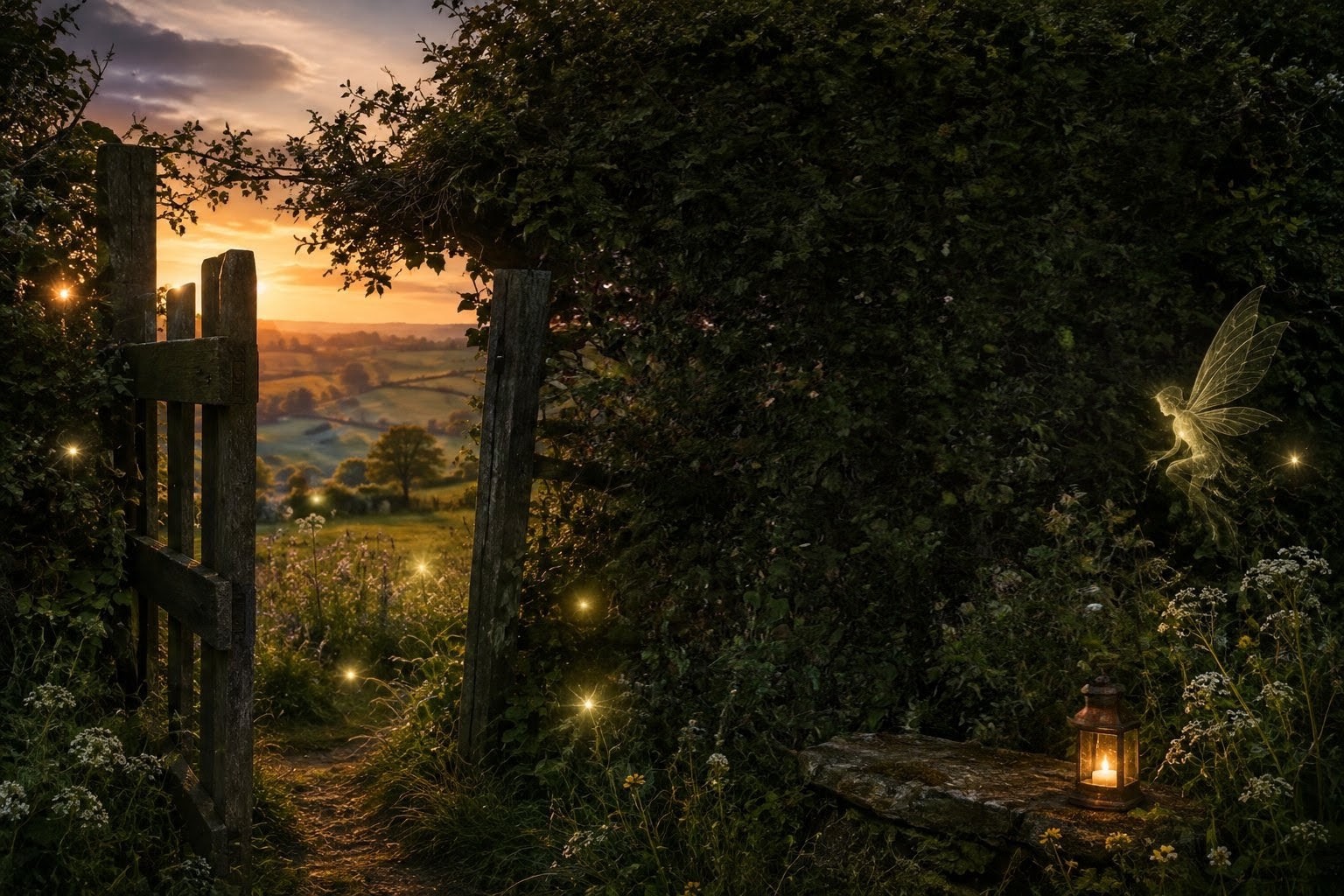
That is also why many of the places associated with the fair folk still exist today. Fairy glens remain tucked away in Scottish valleys. Lonely thorn trees still stand in field despite generations of agricultural change. Ancient mounds continue to rise unexpectedly from otherwise ordinary farmland. Hedgerows still thread their way across Britain, alive with birdsong, blackberries and wildflowers – walk beside one at twilight and it’s easy to understand why our ancestors imagined another world just beyond the leaves.
You don’t have to believe the fair folk wait behind every thorn bush to appreciate what these tales gave us. They encouraged humility. They reminded people that nature deserves respect. The suggested there were mysteries beyond human understanding and that not everything in the landscape was for our use alone. And that is the greatest gift at all. Not proof that another world exists beyond our own, but permission to wonder that it might.
So, next time you find yourself wandering along an old footpath, pause for a moment before you step through the gap in the hedge. Listen to the birds. Notice the wind in the hawthorn and the shadows gathering beneath the trees and ask yourself the question that generations before us knew never to ask too quickly:
“What if we’ve always shared this land?”