There are certain things one does not expect to find when digging up a medieval corpse. A body swollen to grotesque proportions is unfortunate but explicable. A corpse that has apparently been leaving its grave at night is more concerning. And when somebody hits that corpse with a spade and an enormous quantity of blood pours out? At that point, even the most level-headed twelfth-century Yorkshireman might reasonably conclude that something has gone badly wrong.
Welcome back to William of Newburgh.
Earlier this week we met his walking corpse of Berwick – a wicked dead man who wandered the streets at night, frightened the inhabitants into their houses and was eventually dug up, dismembered and burned. But William wasn’t finished. Among the four revenant stories he included in Book V of his ‘Historia rerum Anglicarum’ is another case which, nearly three centuries before the word ‘vampire’ entered Western European consciousness, sounds remarkably familiar. It concerns a jealous husband, an unfortunate fall from the rafters, a devastating epidemic and a dead body containing considerably more blood than anybody expected. And it begins with a man running away from Yorkshire.
William tells us that the man had been guilty of criminal behaviour and fled his native county of York. He eventually settled at a place rendered in translations as ‘Anantis’. Precisely where William meant has been debated, but the story itself is much clearer. The fugitive married but unfortunately, married life did nothing to improve his character. William describes him as a man of thoroughly bad habits who became consumed with jealousy towards his wife. He suspected her of adultery and rather than confronting her, he devised a cunning plan. He would hide above the bedroom and catch her in the act.
Now, I’m sure you’ll agree that there are good ideas and there are bad ideas. And then there is secretly climbing into the roof of your own house to spy on your wife.
The husband concealed himself on a beam above the chamber and his suspicions, unfortunately for everybody involved, appear to have been justified. He saw his wife with another man and became so agitated by what he witnessed that he fell and hit the floor heavily. But he didn’t die immediately.
A priest visited the injured man and urged him to confess his sins and receive the Eucharist but according to William, the unfortunate husband was so consumed by resentment over his wife’s adultery that he postponed confession. Then he died. Unshriven, angry, jealous… and apparently nowhere near finished.
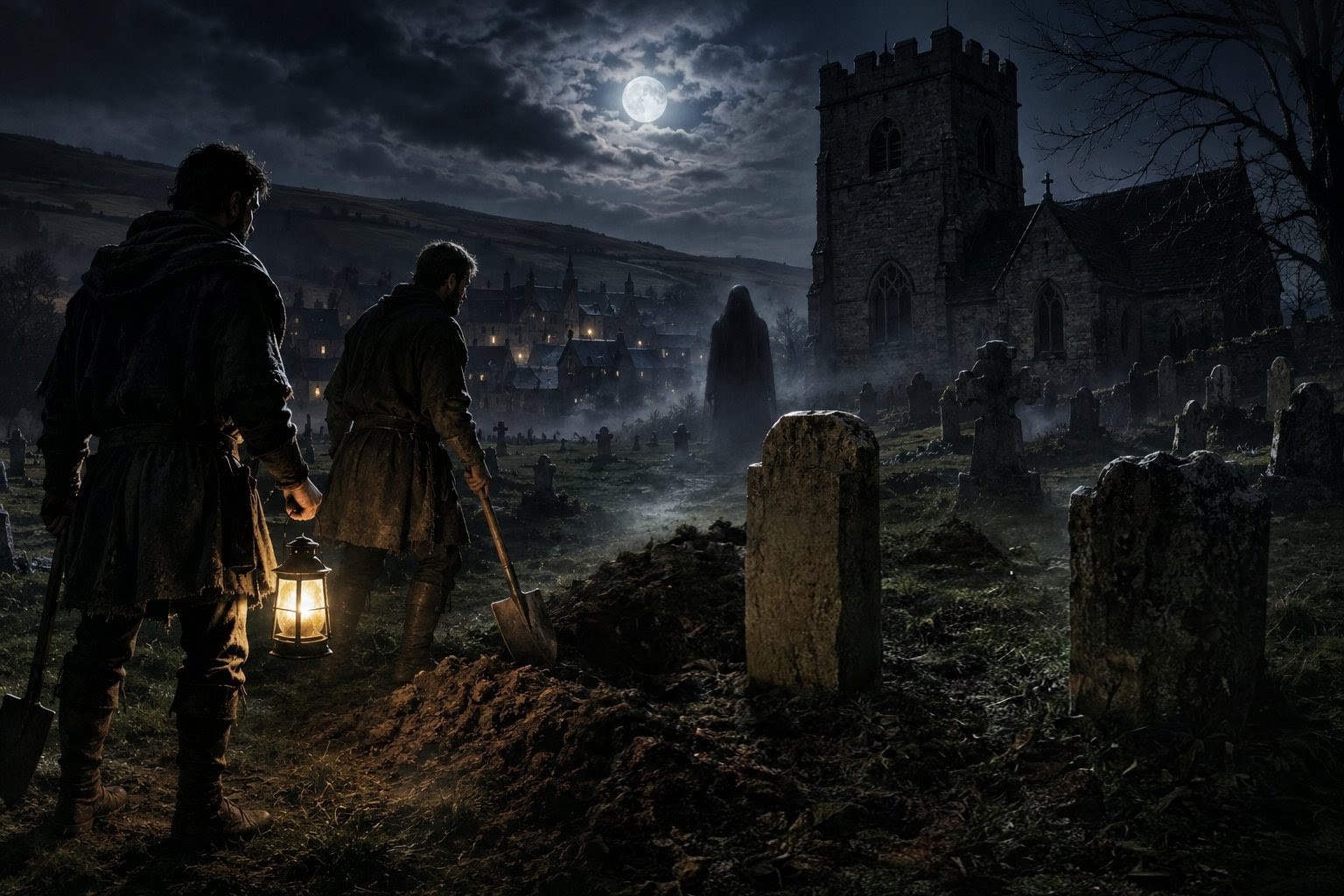
After his burial, strange things began happening. The dead man started wandering. William describes the corpse coming out of its grave at night and roaming through the neighbourhood. People fled from it. Dogs barked and howled. Nobody wanted to encounter the dead husband after dark. Again, this isn’t a ghost in the modern sense. William doesn’t describe a translucent spirit appearing at the foot of somebody’s bed. The body itself is moving.
The community’s problem became considerably worse when people began to die. William links the appearance of the revenant with a terrible pestilence which spread through the settlement. Death followed death and the community emptied. Those who survived fled and eventually, according to William, only a few inhabitants remained. Among them were two brothers whose father had died from the disease. They decided to do something about the corpse and they weren’t going to wait for permission.
While the rest of the community attended church, the brothers went to the cemetery. They opened the grave and there lay the troublesome dead man – except he didn’t look particularly dead. William describes the corpse as having swollen to an enormous size. One of the brothers struck it with a spade.The body split and blood poured out. A lot of blood. In one English translation of William’s Latin, the corpse is described as disgorging such a stream that it appeared:
“as if the leech-like corpse were filled with the blood of many persons.”
And there it is.
The sentence that has caused generations of vampire enthusiasts to sit bolt upright. Because suddenly our medieval revenant isn’t merely walking. It looks as though it has been feeding. The brothers tore out the heart, dragged the body away, built a fire and they burned it. When the corpse was destroyed, William tells us, the pestilence ceased. The dead man stayed dead. Problem solved Medieval Yorkshire style.
Now, this is where terminology becomes tricky. William does not call the corpse a vampire – he couldn’t have done because the English word ‘vampire’ wouldn’t appear for centuries, entering Western European usage during the eighteenth-century vampire controversies centred particularly on eastern and south-eastern Europe. William’s creature belongs to the medieval tradition of the ‘revenant’ – the physically returning dead. But if we forget the label for a moment and simply look at the behaviour, things become interesting.
The man dies in a state of sin and unrest.
His physical corpse leaves the grave.
He wanders at night.
Dogs react violently to him.
His presence is associated with illness and death.
When exhumed, his body is swollen.It contains an apparently extraordinary quantity of blood.
His heart is removed.
His corpse is burned
And once the body is destroyed, the deaths stop.
If we encountered essentially the same description in an eighteenth-century account from Serbia, we would have very little hesitation in recognising it as part of the vampire tradition. So why isn’t William’s corpse a vampire?
Mostly because “vampire” is a later cultural category.
The medieval English dead had their own traditions, theological explanations and folkloric context. Calling every restless corpse in history a vampire risks flattening hundreds of years of different beliefs into one monster. But it would be equally foolish to pretend there are no similarities. There very obviously are.
There’s another possibility.
The dead man may have looked exactly as William’s story says. Not because he had been wandering around drinking his neighbours. But because he was decomposing.
Human decomposition is not always the neat process imagined by people unfamiliar with dead bodies. Depending upon temperature, burial conditions and time since death, gases produced during decomposition can cause the abdomen and other tissues to swell dramatically. A corpse can become bloated. Pressure builds internally. Fluids can emerge from the mouth and nose. Skin changes colour. And blood within the body does not instantly become a dry brown crust simply because the heart has stopped beating. If an already bloated corpse is cut open with a spade, the result can be unpleasantly dramatic. To someone expecting a corpse to be pale, dry and peacefully decaying, the sight of a swollen body releasing dark fluid could suggest something entirely different. It could look well fed. And that misunderstanding would become enormously important in later vampire history.
During the famous eighteenth-century vampire investigations in eastern Europe, witnesses repeatedly treated the condition of exhumed bodies as evidence of supernatural activity. Fresh-looking skin. Blood around the mouth. Swollen bodies. Flexible limbs. Growth of hair or nails. These things could be interpreted as signs that the dead person was not truly dead. Modern forensic knowledge offers mundane explanations for much of it. But imagine opening a grave without that knowledge. The neighbour you buried recently is bloated. His face looks different. There appears to be blood around his mouth. You cut him. Liquid comes out. And several people in the village have died since his burial. The supernatural explanation suddenly doesn’t seem quite as ridiculous as it does from a comfortable twenty-first-century chair.
The pestilence in William’s story is just as important as the blood. Both this revenant and William’s corpse at Berwick are associated with disease. That reflects medieval ideas about corrupted air and putrefaction. Rotting matter smelled foul. Disease appeared to spread through communities. Without germ theory, connecting the two was entirely reasonable. The wandering corpse therefore wasn’t merely frightening. It was dangerous to public health. At Berwick, William specifically describes fears that the corpse would contaminate the air. At Anantis, the revenant’s appearances and the epidemic become intertwined. The dead man is effectively poisoning the community and that concept survives remarkably well into later vampire folklore. The vampire isn’t always primarily a blood-drinking seducer, often its defining feature is simpler:
people begin dying after somebody else has been buried.
One death becomes two.
Two become five.
A family is devastated.
A village suffers.
Eventually someone asks the question. Who died first? Then they open the grave.
This pattern appears repeatedly in historical vampire scares. An epidemic strikes. People die. The first or an early victim becomes suspected of somehow causing the subsequent deaths. The body is exhumed. Natural features of decomposition are interpreted as evidence that the corpse remains active. Then the body is treated.
Staked. Decapitated. Burned. Its heart removed.
Or some combination of the above. If the outbreak subsequently declines – as outbreaks eventually do – the treatment appears to have worked. The corpse was responsible. The corpse was destroyed. The deaths stopped. Proof. William’s twelfth-century account already contains almost the entire structure and that is what makes it so fascinating.
William himself seems to have recognised that these accounts were peculiar. When introducing his tales of returning corpses, he remarks on the difficulty of finding ancient precedent for such events. This wasn’t simply another familiar theological category, something odd was happening in the stories reaching him. Medieval Christianity had ways of understanding returning souls. Ghosts could appear, the dead might seek prayers, a soul could return with a warning or request. But a physical corpse climbing out of the grave was considerably more awkward. William therefore interprets his revenants within a Christian moral universe. Notice who comes back. The wicked, sinful and badly behaved. The unrepentant. Our jealous husband doesn’t merely die. He dies without completing confession and reconciliation. His condition after death reflects his condition at death. He is spiritually unresolved and physically restless. And his neighbours pay the price.
But did any of it happen? We should apply the same rules here that we applied to Croglin. William of Newburgh is a medieval historical source, but hat does not make everything he records a historical event in the modern evidential sense. He was writing stories he had heard and those stories had travelled. They may have changed. They also served his religious purposes. I cannot demonstrate that a corpse genuinely wandered through a Yorkshire settlement at night. Nor can I establish that two brothers really opened its grave, found it bloated with blood, removed its heart and burned it. But I can establish something extremely interesting. Around the end of the twelfth century, an educated English churchman believed stories of physically returning corpses were sufficiently credible, significant or culturally meaningful to preserve them in a serious historical work and the people within those stories knew exactly what to do when one of those corpses became troublesome – Open the grave. Examine the body. Destroy it – That tells us something very real about medieval relationships with death.
The modern vampire is the product of many traditions layered together – Eastern European folklore, Eighteenth-century medical and theological controversy, Romantic literature… The Vampyre. Varney. Carmilla. Dracula. Theatre. Film. Eventually we get the creature everybody recognises: fangs, blood, coffins, stakes and an inexplicable enthusiasm for evening wear. William’s revenant belongs to a different world but looking backwards from the vampire traditions that followed, the resemblance is difficult to ignore. Here, in a text written around the end of the twelfth century, is a corpse that rises from its grave and brings death to the living. When exhumed it is swollen. When cut open it appears filled with blood. Its heart is torn out. Its body is burned. And only then does the community recover. We shouldn’t call it a vampire simply because the word is convenient. But perhaps we can say this:
the vampire had not yet acquired its name, but some of its habits were already wandering around medieval Britain. And frankly, our anonymous revenant of Anantis had one considerable advantage over Dracula.
Nobody needed months of research, ancient books, hypnotism, blood transfusions and an international chase to destroy him.
Two Yorkshire brothers waited until everybody went to church. Then they fetched a spade.
Job done.