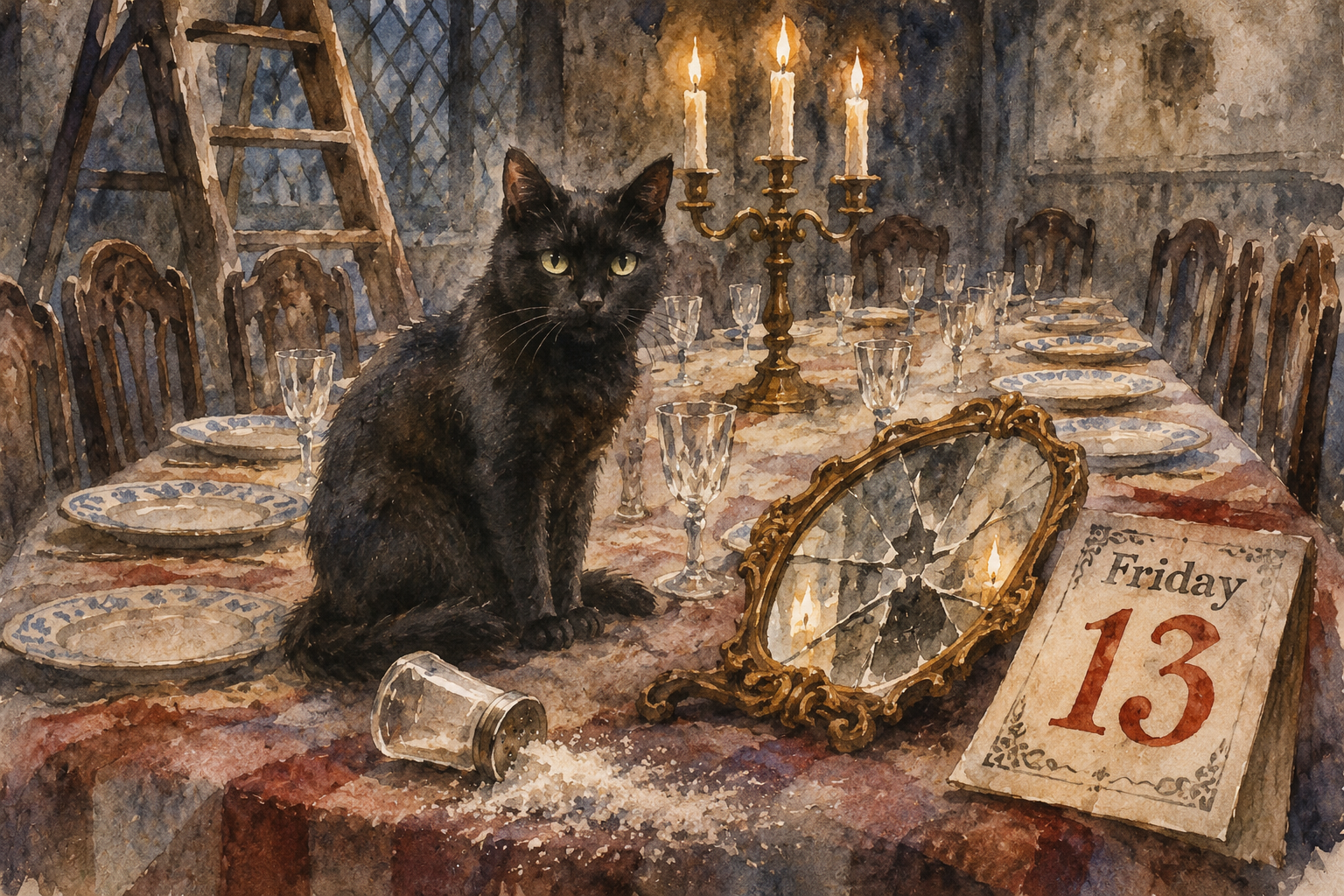
Don’t walk under a ladder. Avoid breaking mirrors. Keep an eye on black cats. And whatever you do, don’t make any important plans for Friday the thirteenth. But why? The answer involves an unlucky dinner party, a determined group of nineteenth-century sceptics, a Wall Street swindle and a rather unfair accusation against the Knights Templar.
Well, here we are again. Friday the thirteenth. That most unfortunate date on which perfectly sensible people suddenly become suspicious of black cats, refuse to walk beneath ladders and begin wondering whether they ought to postpone anything more adventurous than putting the kettle on.
For some, it’s all a bit of fun. For others, the date inspires genuine anxiety. And for the rest of us, it’s an excellent excuse to investigate how an ordinary square on the calendar acquired such a dreadful reputation.
Because there’s something rather peculiar about Friday the thirteenth. We all know it’s supposed to be unlucky, but when you ask p why, the explanations become increasingly imaginative. Some blame Judas Iscariot. Others point to Norse mythology. Quite a few insist that the whole business began when the Knights Templar were arrested in medieval France. And then there’s the theory that the number thirteen is inherently unlucky because twelve is such a lovely, orderly number.
Twelve months. Twelve signs of the zodiac. Twelve apostles. Twelve hours on the clock. Thirteen, apparently, arrives like an uninvited relative at Christmas dinner and spoils everything. It’s a charming explanation. Unfortunately, charm and historical evidence aren’t quite the same thing. To understand Friday the thirteenth, we need to separate its two ingredients.
First, the number.
The superstition surrounding thirteen has a considerably longer documented history than the combined date. One particularly persistent belief held that inviting thirteen people to dine together was asking for trouble. Someone at the table, according to certain versions of the tradition, would die within the year. The obvious Christian association is the Last Supper, where Jesus dined with his twelve apostles before his arrest and crucifixion. Thirteen people at the table, followed by betrayal and death. It’s not difficult to see how later generations might have found that unsettling. But we should be careful about declaring the Last Supper the proven origin of every superstition involving thirteen. Folklore rarely develops so neatly, and an explanation that sounds plausible isn’t necessarily the one people originally believed.
By the seventeenth century, English references to the supposed danger of thirteen at dinner were appearing in print. The belief became increasingly familiar over the following centuries. Some hosts went to considerable lengths to avoid having precisely thirteen guests. Others simply invited another person. Which must have been rather awkward for the unfortunate individual summoned at the last minute to prevent somebody else dropping dead.
Then there’s Friday.
In Christian tradition, Friday carried solemn associations because Jesus was crucified on Good Friday. Over time, various other misfortunes were also assigned to Fridays in popular belief. Some traditions claimed that Eve tempted Adam on a Friday, although that is not something established by the biblical text. Friday acquired a reputation as an inauspicious day for certain activities. Sailors were sometimes warned against beginning a voyage on a Friday. Other people considered it unwise to marry, start a new undertaking or move house on that day. The details varied enormously by place and period, as folk beliefs generally do. And Friday was by no means universally unlucky. Good Friday itself, despite its solemn religious significance, was associated with beneficial customs in some communities, including particular beliefs about planting, baking and healing. Folklore has never been especially troubled by consistency.
So we have an unlucky number and an unlucky day. Surely, then, putting them together must have produced an ancient and terrifying superstition?
Not necessarily. And this is where the story becomes rather interesting.
The combination of Friday and thirteen as a particularly unfortunate date is much harder to trace than either belief on its own. In fact, some of the earliest clear references identified by folklorists appear not in medieval England, but in nineteenth-century France.
In 1834, French publications were already making connections between Fridays, the number thirteen and misfortune. One theatrical character complained of having been born on Friday, 13 December 1813, and attributed his troubles to the circumstances of his birth. By the middle of the nineteenth century, similar references were appearing in French popular culture.
Now, that doesn’t prove somebody in France invented the superstition in 1834. Folklore usually circulates orally before it reaches the printed page. But it does tell us something important. The belief was being expressed in recognisable form long before the twentieth century, and we cannot simply credit its invention to an American novelist in 1907, as some popular histories do.
That novelist was Thomas William Lawson. His book, Friday, the Thirteenth, appeared in 1907 and told the story of a financial operator exploiting superstition to cause panic on Wall Street. It’s an entertaining premise. If investors can be persuaded that a particular day is destined for disaster, perhaps they can be frightened into making the very decisions that bring disaster about. Lawson’s novel undoubtedly helped publicise the date. But it did not invent the fear. Indeed, the story depends upon its characters already knowing that Friday the thirteenth is supposed to be unlucky. Otherwise, the entire plot would fall flat. And before Lawson’s novel appeared, another group of Americans had already decided that the best way to deal with superstition was to make an absolute nuisance of themselves.
Enter the Thirteen Club.
Founded in New York by William Fowler in the early 1880s, this splendid organisation was dedicated to challenging the idea that ordinary objects, dates and activities could bring bad luck. Its members deliberately gathered in groups of thirteen. They walked beneath ladders. They spilled salt. They broke mirrors. They did practically everything that a superstitious Victorian might have considered an invitation to catastrophe. And then, having thoroughly tempted fate, they sat down to dinner. One of the club’s earliest gatherings took place on Friday, 13 January 1882.
The members were not merely ignoring superstition. They were actively trying to demonstrate how ridiculous they considered it. Imagine the scene. Thirteen gentlemen in formal evening clothes, solemnly walking beneath a ladder before sitting down at a table decorated with unlucky symbols. The sort of dinner party at which somebody might deliberately knock over the salt cellar and receive a round of applause. And, as far as the evidence suggests, the universe declined to strike them dead on the spot. The club became well known and attracted prominent supporters, including several American presidents as honorary members. There is something wonderfully Victorian about the whole enterprise. If superstition insists that thirteen people at dinner will bring disaster, the obvious response is to organise a society devoted to eating dinner in groups of thirteen. Preferably while breaking mirrors. I rather admire their commitment.
But what about the Knights Templar?
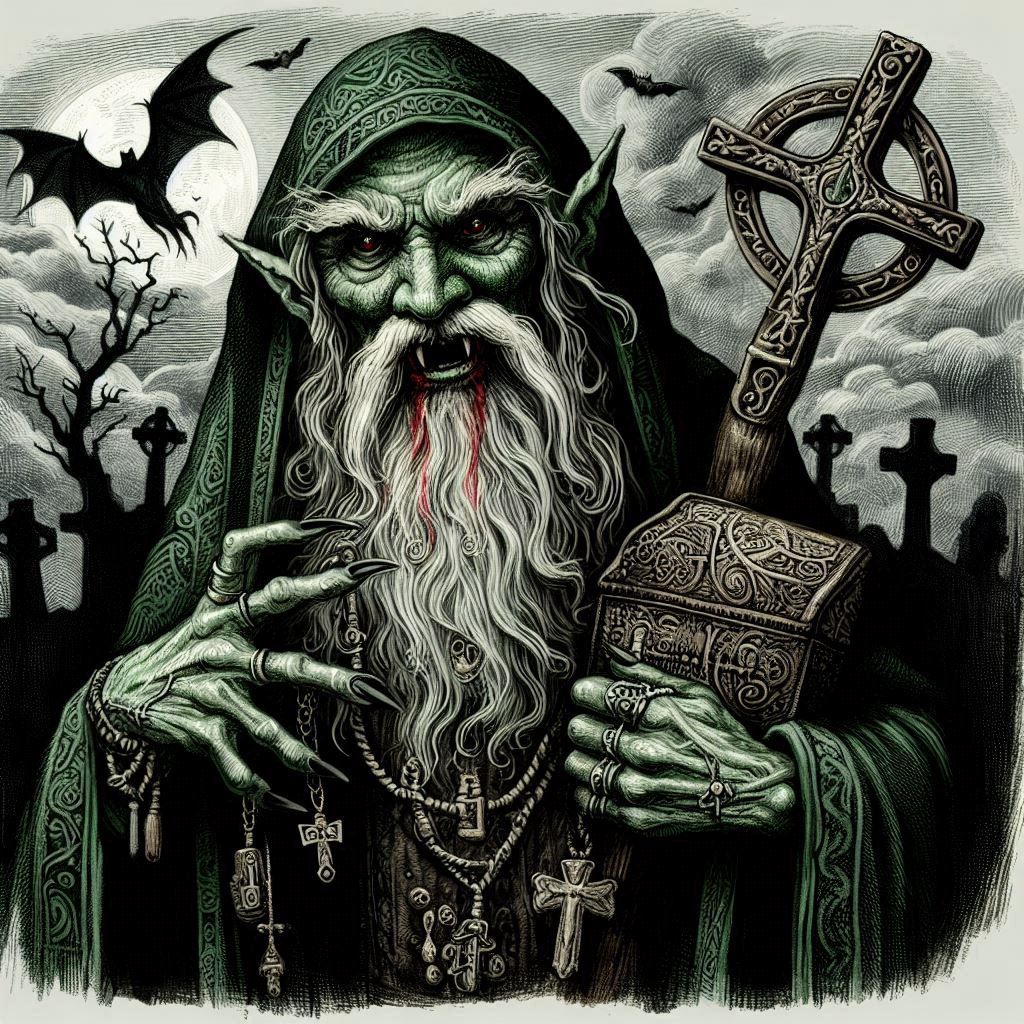
Ah, yes. The Knights Templar. No investigation into Friday the thirteenth would be complete without somebody dragging a medieval military order into the proceedings.
The story usually goes something like this. On Friday, 13 October 1307, King Philip IV of France ordered the arrest of the Knights Templar. The arrests led to imprisonment, torture, confessions extracted under pressure and, eventually, the destruction of the order. Because this happened on Friday the thirteenth, people supposedly began regarding the date as unlucky. It’s a dramatic explanation. It involves powerful kings, secretive knights, religious persecution and a date that fits the superstition perfectly. There’s just one rather substantial problem.
We have no convincing evidence that the arrests of the Templars created the Friday the thirteenth superstition.
The arrests really did begin on Friday, 13 October 1307. That part is historical fact. But the connection between those events and the supposed unluckiness of the date appears to be a much later interpretation. There is no established chain of medieval sources showing that people began fearing every Friday the thirteenth because of what happened to the Templars. The explanation gained considerable popularity in modern times, particularly through the enormous success of Dan Brown’s The Da Vinci Code. And this is one of those moments when a good story has managed to outrun the evidence. The Templars suffered a terrible fate. That doesn’t make them responsible for everybody being nervous about the calendar.
Norse mythology has been recruited into the argument as well. According to a frequently repeated version, twelve gods were enjoying a banquet when Loki arrived as an unwanted thirteenth guest. His arrival supposedly led to the death of Baldr, establishing thirteen as a number of misfortune. There’s a problem here, too. The surviving medieval Norse accounts of Baldr’s death do not present the familiar dinner-party story in that form, complete with twelve guests and Loki arriving as number thirteen. The myth of Baldr’s death is real. The neat explanation involving thirteen divine dinner guests is not securely supported by those texts. It’s another example of something that sounds ancient because it involves ancient characters.
And there are plenty more. People sometimes claim that Friday the thirteenth has been feared since biblical times, or that the date was universally dreaded across medieval Europe. But those claims go far beyond the evidence. The history is considerably messier, more interesting and rather more human and it raises a wonderful question.
If Friday the thirteenth isn’t an ancient, universally recognised day of disaster, why has it become so successful?
Part of the answer may lie in the way people notice coincidences.
Suppose you spill your tea, miss the bus and discover that the washing machine has packed up on an ordinary Tuesday. You might complain about having a rotten day. But if the same things happen on Friday the thirteenth? Suddenly, the calendar becomes a suspect. We remember the incidents that fit our expectations and pay less attention to the countless Fridays the thirteenth on which absolutely nothing unusual happens. Psychologists call this sort of selective attention confirmation bias. And folklore has been making excellent use of it for centuries.
The date also offers a wonderfully convenient explanation for misfortune.
Something goes wrong? Well, it was Friday the thirteenth. No need to examine the faulty ladder, the worn-out tyres or the fact that somebody left the house twenty minutes late. Blame the date.
Then, of course, popular entertainment got involved. By the twentieth century, Friday the thirteenth had become familiar enough to appear in cartoons, newspaper jokes, advertising and popular fiction. And in 1980, the release of the horror film Friday the 13th gave the date an entirely new cultural identity. Suddenly, it wasn’t merely a day for avoiding ladders and black cats. It was a title associated with masked killers, summer camps and an apparently inexhaustible supply of unfortunate teenagers. The film didn’t create the superstition, any more than Lawson’s novel had. But it helped make the date instantly recognisable to audiences who might never have given much thought to its older folklore.
And that brings us to the black cat. Poor creature.
Few animals have suffered quite so much from the human habit of attaching supernatural meaning to perfectly ordinary behaviour. Depending on where you live, a black cat crossing your path may be considered lucky, unlucky or entirely irrelevant. In some British traditions, black cats have been regarded as fortunate, particularly in connection with households and seafaring families. Elsewhere, their association with witches and the supernatural has given them a more sinister reputation. The cat, naturally, has no opinion on the matter. It is simply trying to get across the road. And yet, on Friday the thirteenth, the poor thing becomes an accessory to a cosmic conspiracy.
Ladders, broken mirrors and spilled salt have their own histories, too. They didn’t all spring from the same source, and they certainly weren’t invented specifically for Friday the thirteenth. Rather, the date has become a convenient gathering place for all manner of existing superstitions. A sort of annual convention for bad luck. Although, strictly speaking, it isn’t annual. Every year has at least one Friday the thirteenth, and some have three. The date is simply an unavoidable consequence of the calendar. There is no mysterious force arranging it. No medieval curse waiting patiently to activate. No disgruntled Templar knight peering over the edge of eternity and deciding that your car battery ought to go flat. Just the ordinary passage of days. Which, admittedly, is rather less exciting.
But perhaps the most interesting thing about Friday the thirteenth is not whether it’s unlucky. It’s how successfully the idea has survived. People who would never dream of taking an omen seriously will still make a joke about the date. Someone who happily walks beneath a ladder on Wednesday may hesitate before doing so on Friday the thirteenth. And even the most determined sceptic might feel a tiny flicker of satisfaction when the day passes without disaster. Superstition doesn’t always require belief. Sometimes it survives simply because we enjoy telling the story. And there is something rather comforting about having a familiar villain to blame when life goes wrong.
So, if you’re reading this on Friday, 13 November, I have some advice.
Go about your business. Make your plans. Say hello to the black cat. And if you happen to find yourself sitting down to dinner with twelve other people, don’t panic. The Thirteen Club managed it rather splendidly. Although I would probably leave the mirror-smashing out of the evening’s entertainment. Replacing mirrors is expensive.
And that really would be bad luck.