Across Britain’s fields and woodlands, mysterious circles appear in the grass, sometimes marked by mushrooms, sometimes by nothing more than a ring of unusually vivid green. Science can explain how they grow, but for centuries people believed they marked the dancing grounds of the fairies. And stepping inside one was not always a good idea.
There are few things quite so enchanting as coming across a fairy ring when you least expect it. Perhaps you are walking through an old meadow on a misty autumn morning, or wandering along a woodland path where the sunlight has barely managed to penetrate the canopy, when you notice something rather peculiar. There, among the grass or fallen leaves, is an almost perfect circle of mushrooms, each standing at a remarkably even distance from its neighbours. Sometimes there are no mushrooms at all, merely a darker ring of grass, greener and more vigorous than the vegetation around it. Whatever its appearance, the effect is strangely deliberate, as though somebody has taken the trouble to mark out a little dancing floor in the middle of nowhere.
And according to generations of British country folk, that is precisely what somebody has done.
The somebody in question, however, was not a farmer, a gardener or a particularly enthusiastic party organiser. The circles belonged to the fairies, and anyone foolish enough to disturb them might discover that the Little People were considerably less accommodating than their modern reputation suggests.
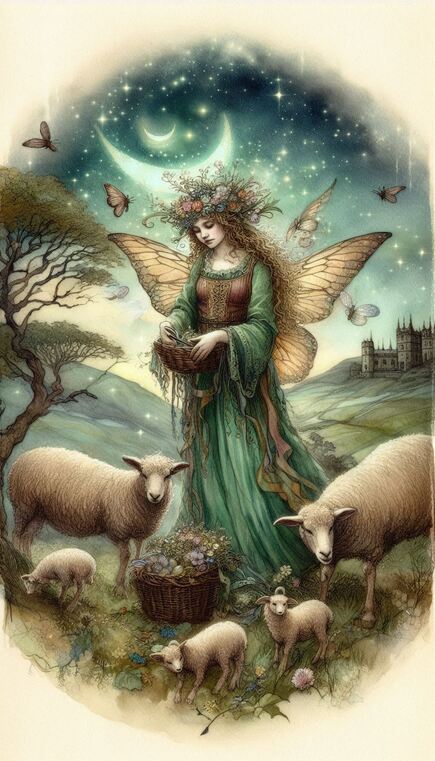
Long before fairy wings, glittering wands and miniature pastel-coloured dresses became familiar features of children’s entertainment, the fairies of British tradition were regarded as powerful and unpredictable neighbours. They might bring prosperity, offer assistance or reward kindness, but they could just as readily lead travellers astray, steal livestock, spoil milk or carry unsuspecting human beings into their own mysterious world. They belonged to a landscape that was both familiar and strangely inaccessible, inhabiting the hills, woods, streams and ancient places that people passed every day without necessarily understanding what might be hidden there.
A fairy ring was one of the few visible indications that these elusive neighbours had been about their business.
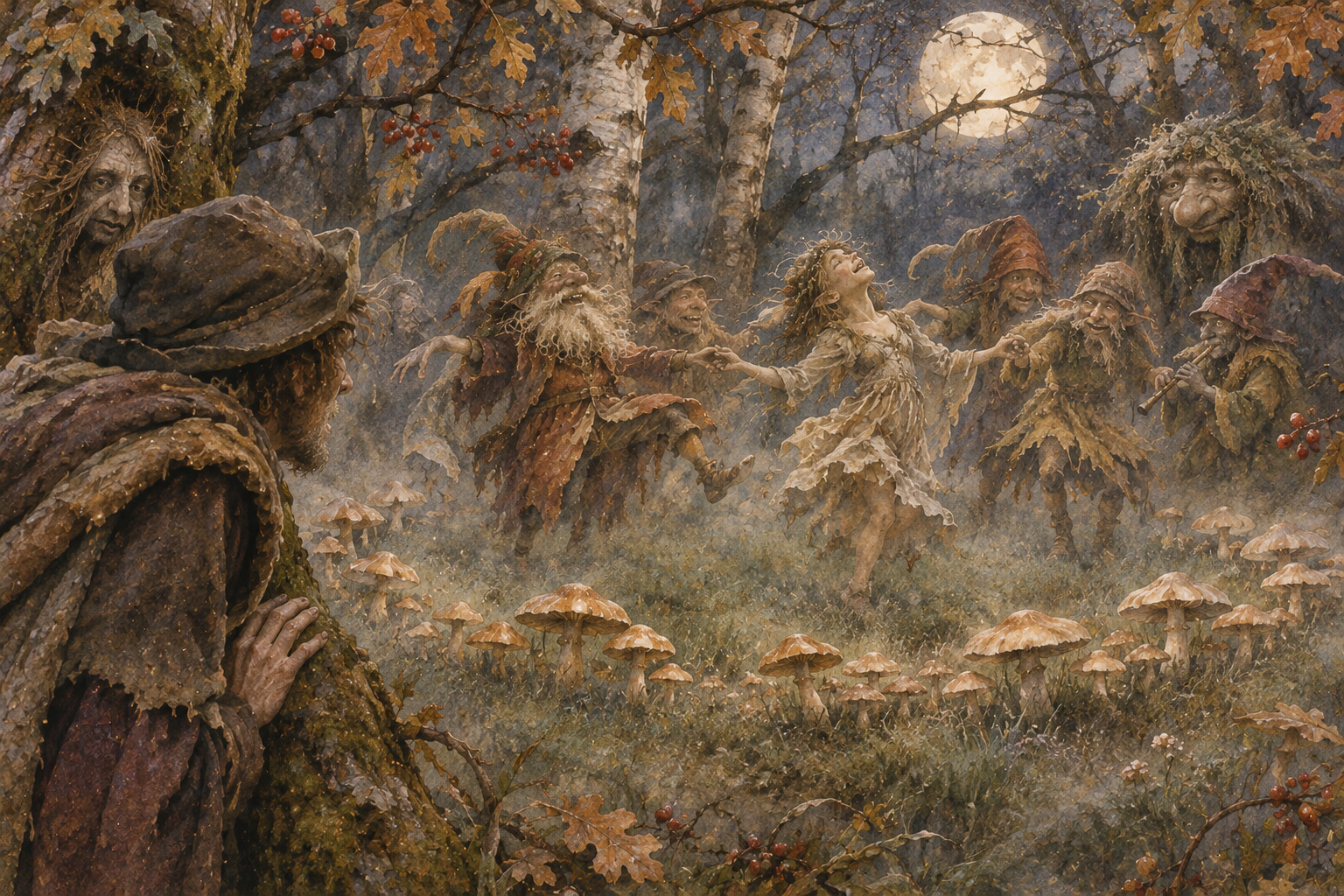
The explanation was wonderfully straightforward. At night, when respectable human beings were safely tucked up in bed, the fairies gathered beneath the moon and danced in a circle, joining hands and turning together until the grass beneath their feet was flattened or changed in colour. By morning, the dancers had vanished, but the marks of their revelry remained. Sometimes mushrooms sprang up around the edge, forming a perfect boundary between the ordinary world and the mysterious territory of the Good Folk.
The belief was particularly well established in Wales, where the fairies were often known as the Tylwyth Teg, meaning the Fair Family. In his Welsh Folk-Lore, published in 1896, the Reverend Elias Owen recorded numerous accounts of fairy dancing and the strange circles associated with it. These were not merely vague references to supernatural beings having an occasional jig in the countryside. They formed part of a detailed body of traditional belief in which particular places were recognised as fairy dancing grounds, and local people understood that certain areas were best approached with caution.
Owen recorded traditions associated with places such as Moel Famau and the hills of north-east Wales, where fairy gatherings were believed to have taken place. The rings were described as green circles, sometimes oval rather than perfectly round, in which the fairies danced through the night. They were supposed to be especially beautiful when seen beneath the moon, with delicate figures moving in elaborate patterns to music of an almost irresistible sweetness.
That music was often the real danger.
In one Welsh tale recorded by Owen, a young man encounters fairies dancing within a ring and is so enchanted by their music and movements that he joins them. To him, the festivities appear to last only a short time, but when he eventually returns to ordinary life, he discovers that a far greater period has passed. Such stories belong to a widespread tradition in which time behaves differently within the fairy world. What seems like an evening’s entertainment among the Good Folk might amount to months, years or even generations in the human world.
It is an unsettling idea, particularly when presented as an entirely ordinary risk of accepting an invitation to dance.
One moment you are enjoying yourself in a meadow, and the next your home has disappeared, your friends are dead and nobody remembers who you are. As warnings against joining unfamiliar parties go, it is certainly more memorable than anything offered by modern public health campaigns.
The folklorist Wirt Sikes explored similar traditions in his British Goblins, published in 1880. Among the stories he collected was an account of a farmer who came upon a company of the Tylwyth Teg dancing in a ring and decided to join them. The music and movement proved irresistible, and the unfortunate man was drawn into their company. When another person eventually discovered him, the farmer was still dancing, apparently unaware of the passage of time. His rescue required intervention from someone who understood the dangers of the fairy circle.
In such stories, the boundary of the ring was enormously important. Outside it lay the familiar world of fields, farms and ordinary human responsibilities. Inside it, the rules were different, and the person who crossed that invisible threshold placed themselves at the mercy of powers they could not control.
This idea of a boundary between worlds appears repeatedly in fairy folklore. Hills might open to reveal glittering halls, ancient mounds could conceal magnificent underground dwellings, and particular trees or stones might mark places where ordinary human behaviour was no longer safe. The fairy ring belonged to the same imaginative landscape, a visible sign that the mundane countryside contained hidden territories with their own inhabitants, customs and laws.
Some traditions offered practical advice for those unfortunate enough to become entangled in a fairy dance. In certain Welsh accounts, a person trapped within the ring could be rescued by someone standing outside who took hold of them and pulled them free. Other stories warned that the rescuing hand must be offered with particular care, lest the would-be rescuer be drawn into the enchantment as well. The details varied from one locality and storyteller to another, which is precisely what we should expect from traditions passed down through generations rather than governed by a single, universally accepted set of rules.
Elsewhere, disturbing a fairy ring was believed to invite misfortune. Children were warned not to trample upon the circles, livestock were sometimes thought vulnerable to supernatural interference, and people who damaged the fairies’ dancing grounds might find themselves suffering an unexplained illness or a run of extraordinary bad luck. These beliefs were not identical throughout Britain, and it would be misleading to suggest that every community regarded fairy rings with the same mixture of fear and respect. Nevertheless, the idea that such places belonged to beings who should not be offended appears repeatedly in the folklore record.
There was also a less threatening side to the tradition. Fairy dances could be described as scenes of extraordinary beauty, and the music associated with them was sometimes thought to possess a quality beyond anything human musicians could achieve. In parts of Wales, particular melodies were attributed to fairy performers, while elsewhere the sight of the Good Folk dancing beneath the moon became a favourite subject for poets, artists and storytellers.
The image was irresistible. A quiet meadow, a silver moon, a company of mysterious figures holding hands, and music so beautiful that anyone hearing it might forget the entire world.
Even William Shakespeare drew upon the association between fairies and their nocturnal revels. In A Midsummer Night’s Dream, the fairy world is one of music, dancing, enchantment and distinctly troublesome interference in human affairs. Although Shakespeare’s fairies belong to the theatre rather than directly to the rural traditions recorded by later collectors, his work demonstrates how familiar the idea of fairy festivities had become within English imaginative culture.
Yet one question remained unanswered. What actually caused the rings?
For centuries, people could observe the phenomenon without understanding the extraordinary processes taking place beneath their feet. The circles sometimes appeared in the same places year after year, gradually increasing in diameter, and could reach impressive sizes. Their regular shape suggested some deliberate organising principle, but the explanation lay in a living organism that was largely hidden from sight.
The answer, as modern mycology has revealed, is fungi.
What we commonly call a mushroom is merely the visible fruiting body of a much larger organism. Beneath the ground lies a network of fine fungal threads known as hyphae, which collectively form the mycelium. These threads spread through soil, decaying plant matter and other suitable material, obtaining nutrients and allowing the fungus to grow.
When certain fungi establish themselves in a favourable location, the mycelium may expand outward from its original starting point in a roughly circular pattern. As nutrients become depleted or conditions change in the older central area, active growth and mushroom production are often concentrated nearer the expanding outer edge. Given sufficiently uniform conditions, the result is a ring of fruiting bodies emerging from the ground, each marking part of the same underground fungal colony.
In other words, the mushrooms are not necessarily separate little organisms that have somehow arranged themselves in a circle. They may be the visible reproductive structures of a single, spreading fungal network.
One particularly well-known species is Marasmius oreades, appropriately called the fairy ring champignon. This small mushroom commonly appears in grassland, sometimes producing the beautiful circles that have inspired so many stories. It is by no means the only species capable of forming fairy rings, however, and similar patterns can be produced by numerous other fungi in lawns, meadows and woodland habitats.
The rings do not always contain mushrooms, either. Sometimes the presence of the mycelium alters the condition of the surrounding vegetation, producing a band of unusually lush grass or, conversely, a circle of weakened or dying turf. As the fungus breaks down organic matter, nutrients may become available to nearby plants, encouraging vigorous growth and creating a vivid green ring. Under other circumstances, fungal activity can make parts of the soil difficult to wet, leaving the grass struggling for moisture.
The Royal Horticultural Society recognises several different forms of fairy ring, including those that produce mushrooms, those that affect the colour or vigour of grass, and those that create conspicuous areas of damaged turf. The underlying processes are complex, and not every ring behaves in precisely the same way.
But perhaps the most astonishing feature of the phenomenon is its persistence.
Some fungal colonies continue expanding for many years, their circles growing gradually larger as the mycelium advances through the soil. The mushrooms may appear only when conditions are suitable, but the organism itself can remain present even when there is nothing visible above ground. The ring is therefore not simply an arrangement of mushrooms that happens to emerge after rain. It is the temporary appearance of a much longer-lived biological process, one that may have been developing beneath the meadow for years before anyone noticed it.
And if that is not magical enough, consider that the entire structure is largely invisible.
Beneath an apparently ordinary patch of grass, a living network is spreading, feeding, changing the chemistry of the soil and occasionally producing an almost perfect circle of mushrooms. No tiny dancers are required, yet the result looks remarkably like something arranged by an intelligent hand.
The scientific understanding of fairy rings developed gradually, with naturalists examining their growth and behaviour long before the complex ecology of fungi was fully understood. Early nineteenth-century researchers were already investigating the relationship between underground fungal growth and the mysterious circles, helping transform what had once been regarded chiefly as a supernatural curiosity into a subject of serious botanical study.
And yet the folklore has never entirely disappeared.
Even today, fairy rings attract attention in parks, gardens and woodland clearings, where their unusual shapes encourage people to stop and look. They continue to appear in children’s stories, fantasy literature, modern spiritual traditions and the photographs of anyone fortunate enough to find a particularly beautiful example. The old warnings about stepping inside them are still repeated, sometimes playfully, sometimes with a lingering suggestion that perhaps it would be wiser to walk around.
There is something rather comforting about that persistence. We have learned an enormous amount about the natural world since the first fairy-ring traditions were recorded, yet understanding how something works does not necessarily make it less wonderful.
If anything, the truth is more extraordinary than the explanation once offered by folklore. A fungus that may spend much of its existence unseen can arrange its fruiting bodies in a vast circle, alter the growth of the surrounding plants and continue expanding through the earth for years. It is a remarkable demonstration of the hidden complexity beneath even the most unremarkable-looking meadow.
Of course, the fairies might have a different opinion.
After all, knowing how the mushrooms grow does not explain why they should have chosen such an excellent place to dance, and I suspect the Tylwyth Teg would be thoroughly unimpressed by anyone arriving at their midnight celebrations armed with a field guide to fungi.
So the next time you encounter a fairy ring, stop for a moment and admire it. Look at the delicate mushrooms, the perfect curve of the circle and the curious patch of grass that has chosen to grow so differently from everything around it. Consider the hidden life beneath your feet, and the generations of people who saw the same mysterious pattern and imagined moonlit dancers, enchanted music and invisible kingdoms.
And should you be tempted to step inside, well, that is entirely your decision.
But if you suddenly hear the faint sound of music, and a company of beautifully dressed strangers invites you to join their dance, you might want to remember that the old stories were remarkably consistent about one thing.
It is much easier to enter a fairy ring than to leave one.