It’s very cold in Buxton today. So cold that it makes you wonder how (or why, for that matter) the ancient people who lived here actually survived without modern comforts like heating and hot chocolate. Which is why I have chosen to impart to you today the wonderfully reassuring knowledge that, nearly two thousand years ago, people were approaching the end of November, looking at the miserable weather and diminishing daylight, and deciding that the only sensible response was to organise a party. Not just any party, either. By the sixth century, the inhabitants of the Eastern Roman Empire had developed a winter celebration lasting twenty-four days, complete with feasting, drinking, elaborate ceremonies and enough social obligations to make the modern Christmas party season look positively restrained. It was called the Brumalia, and although it had roots in the religious traditions of ancient Rome, it survived into an age when the Empire was officially Christian, much to the irritation of those who felt that its citizens ought to be behaving themselves.
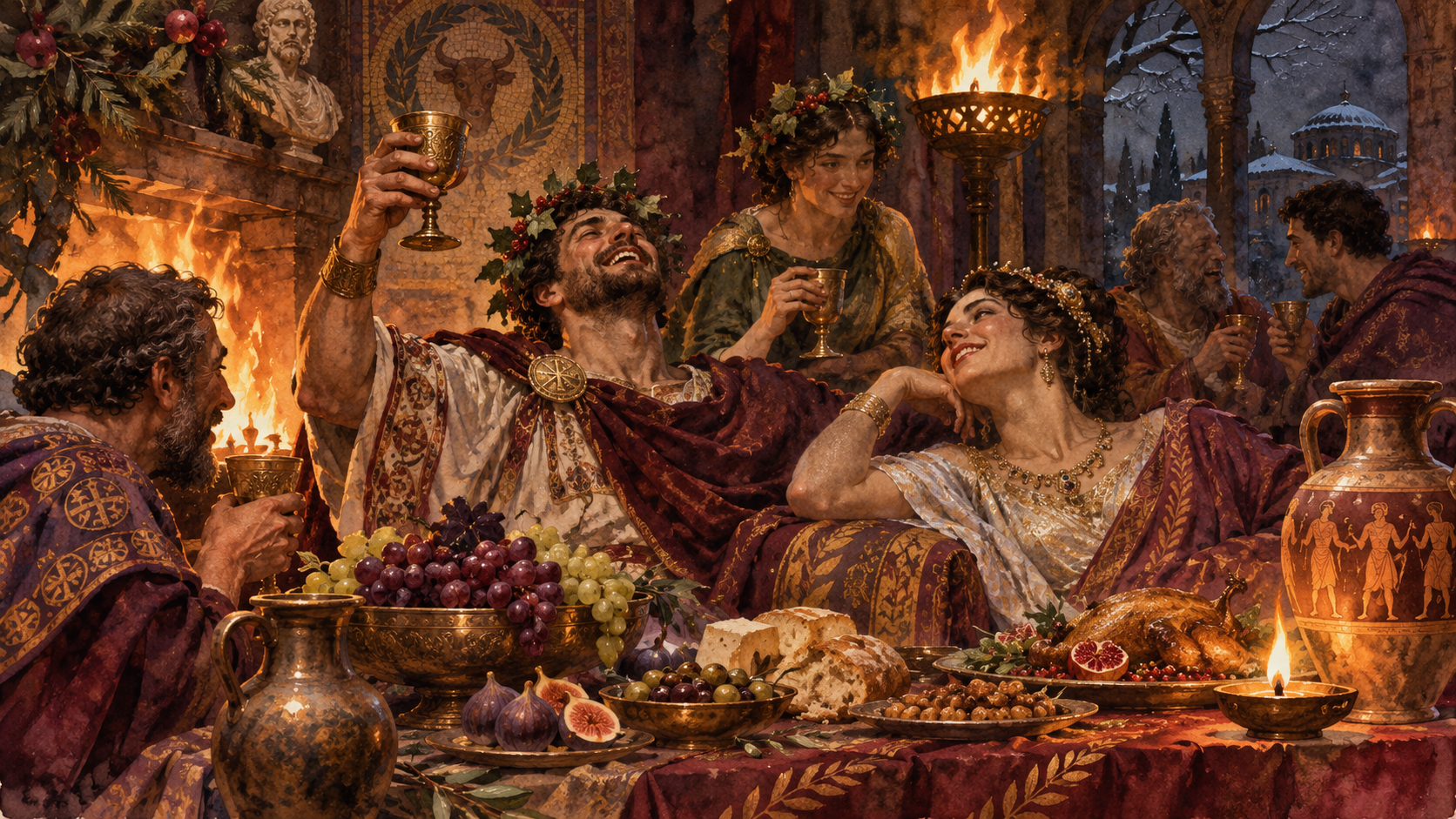
The name comes from the Latin bruma, meaning the shortest day or winter solstice, and the festival was associated with that peculiar stretch of the year when the harvest was finished, the fields were largely quiet and the darkness seemed determined to get the upper hand. There had been an older Roman observance called Bruma, associated with 24 November, but precisely how and when this developed into the much grander Brumalia remains uncertain. What we can say is that, by the sixth century, the celebrations were firmly established in the eastern Mediterranean, particularly in Constantinople, where the festivities ran from 24 November to 17 December. Those twenty-four days were not chosen at random. Each was assigned one of the twenty-four letters of the Greek alphabet, and people celebrated on the day corresponding to the first letter of their name. If you happened to have a particularly extensive circle of acquaintances, you could potentially spend the best part of a month moving from one celebration to another. It was an arrangement that must have been wonderful for the wine merchants, although perhaps rather less so for anyone expected to get up for work the following morning.
Our most colourful description of the Brumalia comes from John the Lydian, a sixth-century official and antiquarian who wrote about Roman customs in his work De Mensibus, or On the Months. John explained that winter traditionally brought a halt to many of the activities that occupied the Roman population during the warmer months, particularly agriculture and military campaigning. Instead, people marked the season with gatherings and good wishes, greeting one another with the words Vives annos, meaning ‘May you live for years’. But there was rather more going on than exchanging seasonal pleasantries. John also described farmers sacrificing pigs in honour of Cronus and Demeter, while vine-growers made offerings of goats to Dionysus, the god of wine. The reasoning behind the latter was that goats were regarded as enemies of the vine, presumably because they had an unfortunate tendency to eat it. Having dispatched the animal, the celebrants apparently inflated its skin and jumped upon it, a custom that sounds rather like an ancient agricultural version of an extremely hazardous children’s party game.
Other offerings included wine, olive oil, grain, honey and the fruits of the harvest, some of which were presented to priests. These were not simply excuses for merriment, although merriment was certainly involved. The rituals reflected a much older understanding of the agricultural year, in which winter was a period of apparent death and concealment rather than an absolute ending. Seeds disappeared beneath the earth, the growing world withdrew into darkness, and the gods associated with fertility and renewal were honoured in the hope that life would eventually return. John linked these customs with the subterranean world and the god Cronus, whose mythology involved his imprisonment in the depths of Tartarus. His explanation was hardly complimentary, however. Writing as a Christian in an empire that had officially abandoned the worship of the old gods, he acknowledged that the Church wanted nothing to do with such festivities.
Yet the Brumalia proved remarkably difficult to get rid of, and one of its most enthusiastic patrons was none other than the Emperor Justinian I, who ruled from 527 to 565. Justinian was hardly a champion of pagan religion. His reign saw determined efforts to strengthen Christian orthodoxy and restrict traditional religious practices, but that apparently did not prevent him from enjoying a suitably grand winter celebration. According to an oration by Choricius of Gaza, Justinian and his wife Theodora observed their Brumalia on consecutive days, because their names began with consecutive letters of the Greek alphabet: theta for Theodora and iota for Justinian. It is a lovely little human detail from an otherwise imposing imperial household. You can almost imagine the administrative headaches of arranging two splendid celebrations back to back, although the emperor presumably had a small army of servants to deal with such practicalities.
Nor was the Brumalia confined to the imperial palace. Surviving papyrus accounts from the great Apion estates in Egypt record distributions of wine connected with the celebration, demonstrating that the festival had a life far beyond the ceremonial halls of Constantinople. That is particularly interesting because it reminds us that the Eastern Roman Empire was not some small remnant clinging to the ruins of Rome, but an enormous, culturally diverse world in which ancient customs could travel, change and acquire new meanings. For an Egyptian estate worker, the Brumalia might mean a welcome distribution of wine. For a Constantinopolitan official, it might involve elaborate social obligations and an appearance at court. For someone still attached to the older religious traditions, it could retain associations with the gods and the turning of the agricultural year. The same festival could mean quite different things to different people, which may have been one of the reasons it survived for so long.
By the tenth century, the imperial celebrations had become astonishingly elaborate. The Book of Ceremonies, compiled under Emperor Constantine VII Porphyrogenitus, describes a carefully orchestrated world of processions, magnificent costumes, formal greetings, singing, dancing, banquets and gifts. High-ranking officials appeared in their ceremonial clothing, arranged according to their status, while the emperor presided over the proceedings and distributed purses containing gold coins. There were songs praising the sovereign, elaborate dining arrangements and torchlit departures. Interestingly, the ceremonial account also included an invocation of the Virgin Mary, suggesting how thoroughly an old seasonal celebration could be adapted to its Christian surroundings. This was no longer simply a matter of farmers honouring agricultural deities beneath the winter sky. It had become an imperial spectacle, designed in part to demonstrate generosity, authority and the enduring grandeur of Constantinople as the New Rome.
Not everyone was impressed, of course. The Church’s hostility towards customs associated with pagan worship persisted, and ecclesiastical authorities condemned or attempted to suppress such festivities on more than one occasion. The Council in Trullo, held in 691–692, prohibited various celebrations and practices regarded as pagan survivals, while further objections appeared during the eighth century. Yet the Brumalia continued to find supporters, including among the emperors themselves. Constantine VII even revived the imperial celebration after an interruption under Romanos I Lekapenos. This was not necessarily evidence of secret paganism lurking beneath Christian robes. More probably, the festivities had become so thoroughly embedded in the social and ceremonial life of the Empire that abandoning them was neither particularly appealing nor politically useful. There is, after all, a considerable difference between worshipping Dionysus and enjoying a banquet that happens to have descended from celebrations once associated with him.
It is tempting to regard the Brumalia as an early version of Christmas, particularly because of its winter setting, its feasting and its emphasis on sociability, but that would be rather too simple. The traditions developed in different ways, and there is no straightforward line connecting every Brumalia custom with a modern Christmas practice. What the festival does demonstrate is something much more interesting: the remarkable ability of human beings to carry their traditions with them, even when the world around them changes almost beyond recognition. Gods could fall from favour, emperors could rise and vanish, religious authorities could issue prohibitions, and still people found reasons to gather around a table, share food and drink, exchange good wishes and celebrate the passing of another year.
Eventually, the Brumalia disappeared from the imperial calendar, although its precise final chapter is difficult to establish. By then it had endured centuries of religious transformation, political upheaval and changing social customs, beginning as a seasonal observance and developing into one of the great ceremonial occasions of Byzantine life. There is something rather lovely about that persistence. Beneath the gold, the ritual, the theology and the occasional unfortunate goat, the underlying impulse was remarkably familiar. Winter was coming, the days were growing shorter, and people wanted warmth, company and something worth celebrating.
Nearly fifteen hundred years later, with another November drawing to a close, it is difficult to argue with them.
Sources and further reading
- John the Lydian, De Mensibus, Book IV, section 158. English translation.
- Fritz Graf, Roman Festivals in the Greek East: From the Early Empire to the Middle Byzantine Era (Cambridge University Press, 2015), Chapter 7, ‘The Brumalia’, pp. 201–218.
- Elena Nonveiller, ‘The Broumalia Festival from Rome to Byzantium: Continuity or Ideological Reinvention?’, Diogenes, 9 (2020).
- Choricius of Gaza, Oration XIII, on the imperial Brumalia.
- Constantine VII Porphyrogenitus, De Ceremoniis, Book II, imperial Brumalia ceremonies.