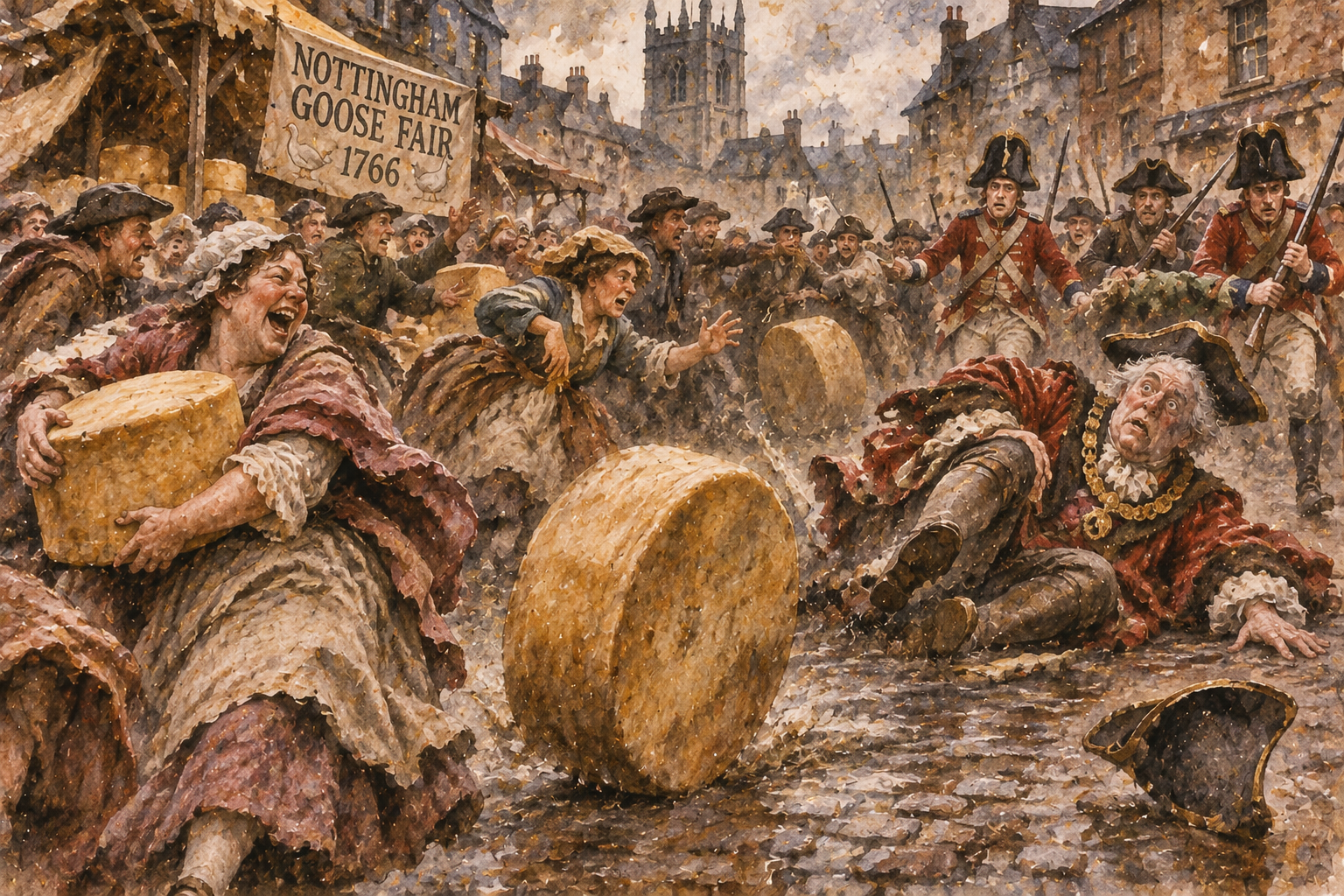
In October 1766, a dispute over the price and ownership of cheese brought Nottingham’s famous Goose Fair to a spectacular halt. Great wheels of cheese rolled through the streets, the military were summoned, and the Mayor reportedly found himself on the receiving end of a particularly determined dairy product.
There are many indignities that might befall a mayor in the course of his official duties. Being shouted at by disgruntled townspeople is probably an occupational hazard, and being obliged to attend endless meetings must surely test the patience of even the most dedicated public servant. But being knocked off one’s feet by a runaway wheel of cheese is an altogether more unusual experience, and one that the Mayor of Nottingham reportedly endured during a particularly memorable disturbance in October 1766. It was an incident so gloriously absurd that it has survived in local history for more than two and a half centuries, although the events surrounding it were considerably more serious than the unfortunate mayor’s encounter with an airborne or rapidly rolling dairy product might suggest.
The trouble began at Nottingham’s Goose Fair, an annual gathering that was already centuries old by the middle of the eighteenth century. Today, the fair is best known for its fairground rides, bright lights and entertainments, but its earlier incarnations were substantial commercial occasions where traders gathered to sell livestock, agricultural produce and all manner of goods. Despite its name, one of its most important commodities was cheese, brought into the town in considerable quantities by farmers, dealers and merchants from the surrounding countryside.
Cheese was not simply an indulgence for Georgian households. It was an important and relatively durable foodstuff, providing a valuable source of nourishment in an age when preserving fresh produce presented considerable difficulties. A large wheel could be stored, transported and sold over time, making cheese a useful commodity for both farming families and commercial dealers. Unfortunately, this also meant that its price could become a matter of considerable public concern, particularly when harvests were poor and ordinary people were struggling to afford sufficient food.
And in 1766, food prices were causing trouble throughout England.
A succession of difficult harvests and mounting economic pressures had produced widespread anxiety about the cost and availability of essential provisions. In towns across the country, crowds gathered to protest against merchants accused of charging excessive prices, withholding supplies or exporting food from communities that feared they might soon go hungry. Such disturbances were not always simply outbreaks of uncontrolled violence. Many reflected a deeply rooted belief that food should be sold at a fair price and that local people had a moral claim to provisions produced or offered for sale in their own region.
This was the atmosphere in which Nottingham’s Goose Fair opened on 2 October 1766.
According to a report published in the Stamford Mercury on 9 October, substantial quantities of cheese had been purchased by commercial dealers, known as factors, and collected together for storage before being transported away. The crowd apparently took exception to the speed and scale of these purchases, particularly because ordinary inhabitants feared that local supplies would disappear before they had an opportunity to buy them.
A separate account, published in the Derby Mercury on 10 October, described merchants from Lincolnshire who had gathered a large quantity of cheese. Their intention to remove it from Nottingham provoked particular resentment. Some members of the crowd insisted that the town ought to be supplied first, and the traders found themselves facing an increasingly hostile gathering.
By seven o’clock that evening, matters had deteriorated considerably.
The crowd descended upon the accumulated cheeses, seizing them, carrying them away and distributing them among themselves. Women and boys were reported to have been particularly active in removing the goods, while the authorities attempted unsuccessfully to protect the merchants’ property.
The magistrates and constables surrounded the cheese and read the proclamation against rioting, but it was no use. The crowd continued until the dealers’ stock had been taken.
One contemporary account makes a particularly interesting observation. The rioters left the farmers’ cheese untouched.
This distinction matters, because it suggests that the disturbance was not simply an indiscriminate attack upon every cheese in sight. The crowd was targeting the goods purchased by commercial middlemen, whose activities were perceived as depriving the local population of food. Whatever we might think of their methods, there was an identifiable grievance behind the commotion.
But the events that followed were anything but orderly.
According to the Derby Mercury, some members of the crowd moved towards the bridges over the Trent, searching warehouses for additional cheese. Others gathered outside the coffee house in Peck Lane, where several people arrested during the disturbance had been brought before the justices. The crowd demanded their release, smashed windows and threatened further destruction.
The authorities, faced with an increasingly volatile situation, decided that discretion was the better part of valour and released the prisoners.
Unfortunately, this did not bring the disturbance to an end.
A messenger was dispatched to Derby shortly before midnight to request military assistance, and detachments of light dragoons arrived in Nottingham the following morning. Their presence helped restore a measure of order, but the peace proved temporary. Further violence erupted, and soldiers eventually fired upon rioters during another confrontation.
At least one man was killed during the disturbances, according to later historical accounts. His death is an important reminder that, beneath the amusing image of cheese rolling through the streets, this was a serious episode of social unrest involving fear, anger and the use of military force against civilians.
And then, of course, there was the mayor.
Later histories of Nottingham record that during the commotion, great wheels of cheese were sent rolling down Wheeler Gate and Peck Lane. The unfortunate mayor, attempting to restore order, was reportedly knocked down by one of them in the marketplace.
The precise circumstances of this extraordinary encounter are difficult to establish. The surviving newspaper accounts confirm the rioting and the seizure of cheese, but the famous collision is more clearly described in later local histories. Some retellings have the cheese hurled at the mayor, while others describe a runaway wheel rolling into him. Either version is sufficiently undignified to have ensured the incident a permanent place in Nottingham’s historical memory.
One can only imagine the scene: the town’s chief civic officer attempting to address an angry crowd, surrounded by shouting townspeople, overturned stalls and an alarming number of liberated cheeses, when a substantial wheel of dairy produce comes hurtling towards him.
It is a moment almost impossible to recount with a straight face.
Nevertheless, the Great Cheese Riot deserves to be remembered for more than the mayor’s misfortune. The people involved were reacting to real economic pressures, and their anger formed part of a wider wave of food disturbances that swept through England during the autumn of 1766. Similar protests occurred in several counties, where communities attempted to prevent grain, flour and other essential supplies from being sold at prices they considered excessive or removed for sale elsewhere.
Historians studying these events have explored the idea of a moral economy, in which ordinary people understood the food trade as something governed not merely by commercial opportunity but by obligations to the wider community. From this perspective, an apparently chaotic crowd might be acting according to a set of expectations about fairness, customary rights and the responsibilities of merchants.
The Nottingham disturbance provides a particularly vivid example. The contemporary distinction between the factors’ cheese and the farmers’ cheese suggests that participants were concerned not simply with obtaining food without payment, but with the activities of those they believed were manipulating its availability.
That does not excuse the violence or the destruction that followed, but it helps explain why an argument over cheese could provoke such extraordinary consequences.
The town eventually returned to something resembling normality, although the riot left a considerable impression upon its inhabitants. The authorities had discovered that public resentment over food supplies could escalate with remarkable speed, and local people had demonstrated just how strongly they felt about the movement and pricing of essential goods.
Over time, the complicated economic grievances and tragic consequences of the disturbance were gradually overshadowed by its most entertaining detail. The mayor and his cheese became the stars of the story, appearing in local histories and popular retellings as an irresistible example of Nottingham’s occasionally rebellious character.
And perhaps that is inevitable. History is full of serious events remembered through a single peculiar incident, particularly when that incident involves a person of considerable dignity being flattened by something entirely unexpected.
Yet the story is all the more fascinating when we remember that both versions of it are true to the historical tradition: the grim account of frightened communities protesting over food, and the wonderfully absurd image of great wheels of cheese escaping down the streets of an eighteenth-century market town.
Today, Nottingham’s Goose Fair remains a celebrated part of the city’s identity, although visitors are considerably more likely to encounter a fairground ride than a large cheese hurtling towards the marketplace.
Still, perhaps the old story offers a useful warning to anyone holding public office.
Never underestimate the anger of a hungry crowd.
And, whatever else you do, keep a very careful eye on the cheese.