Is Buxton haunted by the last wolf in England?

Picture Credit: The Paranormal Database
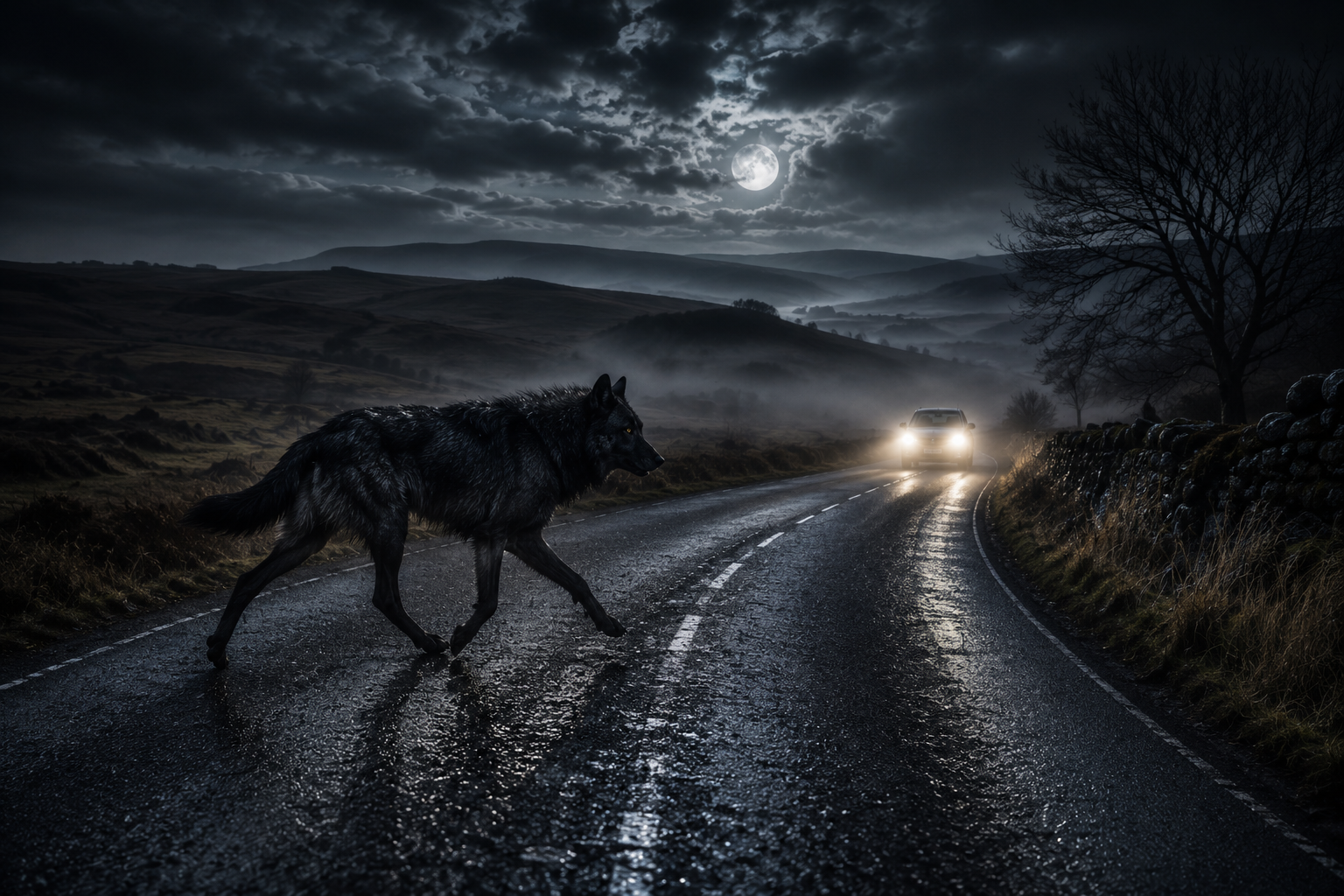
On a dark road just outside Buxton, a driver catches sight of movement ahead. For a moment it appears within the headlights. Large, dark. Wolf-like. Then it is gone. The creature crosses the road with astonishing speed before disappearing into the darkness beyond the beam. The witness slows down, glances into the mirrors and searches the roadside but can see nothing. The landscape remains silent. The animal has vanished.
Stories such as these have circulated around Buxton and the surrounding Peak District for years. Witnesses describe a huge canine shape moving through the darkness, crossing roads, pacing vehicles or appearing unexpectedly before disappearing just as quickly. Some call it a phantom. Others believe it to be an escaped animal, a trick of the light or simple misidentification. Locally, however, it has acquired a name.
The Speed Wolf.
At first glance the legend sounds like a modern cryptid story, the kind of tale born from fast roads, headlights and overactive imaginations. But what if the roots of the legend stretch much deeper? What if the Speed Wolf is not merely a modern mystery but the latest chapter in one of Derbyshire’s oldest stories?
To understand that possibility, we must leave the roads of modern Buxton behind and travel east to the village of Wormhill. Today Wormhill is a quiet Peak District settlement surrounded by fields and limestone uplands and, like many villages in the area, it possesses a history far older than most visitors realise.
For centuries Wormhill was associated with a very different reputation.
Wolves.
According to local tradition, the tenants of Wormhill once paid a curious form of tribute. Instead of money or produce, they were said to present wolf heads as part of their obligations. The details vary depending on the source, but the story survived for generations and became woven into local identity. But even more remarkable than that is another tradition. Wormhill claims a connection to the last wild wolf in England.
Several places across Britain make similar claims, and historians rightly approach such stories with caution. Wolves disappeared gradually rather than dramatically. There was no official ‘final wolf’. Different regions remember different animals, different dates. Yet the Wormhill story endures.
Local tradition holds that an exceptionally large wolf was hunted and killed near Wormhill Hall during the late medieval period. Some versions identify it as the last wolf in England. Others simply describe it as a particularly notorious beast that had terrorised livestock and local communities. The precise facts may never be known but the folklore survived nonetheless.
This is where things become interesting…
Now, most animals vanish from a landscape and are quickly forgotten. Wolves, however, did not. Across Europe they lingered in stories long after they disappeared from forests and hills. They became symbols of wilderness, danger and the untamed world that existed beyond the safety of settlements. People continued telling wolf stories even when nobody alive had ever seen one and the Peak District was no exception.
Generation after generation have inherited memories of wolves through folklore. The creatures remain present in the imagination in the form of shucks, barghests and werewolves long after they vanish from reality.
Perhaps that is the reason we discount them as folklore.
The witnesses who describe this particular beasty rarely report seeing an ordinary dog. They describe something larger. More powerful. More… wolf-like. This creature appears in precisely the same area in modern reports that wolves once occupied in medieval times.
But it appears unexpectedly. It vanishes mysteriously. It almost seems to belong to the margins of the landscape. Most importantly, it refuses to be fully explained.
Folklorists and investigators of paranormal phenomena often speak of landscape memory. Certain stories become attached to particular places and survive for centuries. Sometimes the original event is forgotten. Sometimes the facts become distorted. Yet the story itself persists. Could the Speed Wolf be part of exactly that process? Not a living wolf but some kind of ghost or memory. A fragment of folklore carried forward into the modern age.
Five hundred years ago a traveller crossing the Peak District might have reported a large wolf glimpsed at dusk. Three hundred years ago the story might have become a tale told beside the fire to keep people wandering alone in the dark. One hundred years ago it might have survived as local folklore. Today it appears in Facebook groups, conversations between friends and reports shared online. The medium changes but the story survives.
Of course, there are more mundane explanations.
The Peak District contains many wild animals . Deer can appear surprisingly wolf-like when glimpsed briefly. Darkness distorts perception. Fog transforms ordinary shapes into extraordinary ones. Motorists travelling at speed can misjudge size and distance in an instant. Every cryptid investigator knows these possibilities must be considered.
Yet dismissing the Speed Wolf entirely misses the point. Folklore is not valuable because every story is true. Folklore is valuable because it reveals what people believe, fear and remember. The story of the Speed Wolf tells us something important about the Peak District:
Despite roads, streetlights and smartphones, mystery remains. The moors still possess the power to surprise us. Ancient stories still find new ways to survive. And somewhere beneath this particular modern legend lies the shadow of a very old animal that once genuinely walked these hills.
The real wolves are gone. The memory remains. Perhaps that is why the legend refuses to die.
On a winter evening outside Buxton, a driver rounds a bend and catches sight of a large shape moving impossibly fast across the road ahead. By the time they react, it has vanished. Perhaps it was a dog, perhaps it was a deer. Perhaps it was merely a trick of the light.
Or perhaps the last wolf in England is still trying to find its way home to Wormhill.


Leave a Reply