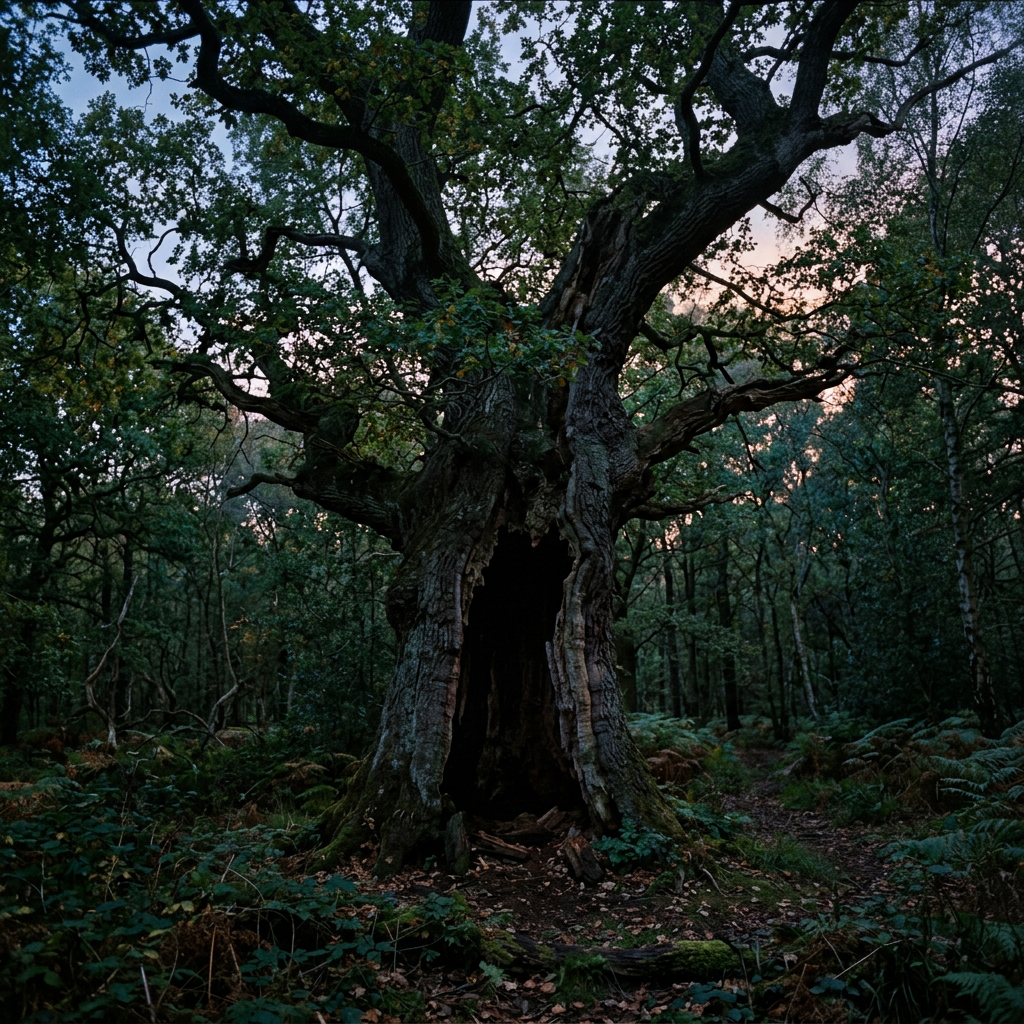
There are some losses that reach beyond the practical. The death of a tree is, on the face of it, an ordinary thing. Yet I feel it’s appropriate to honour this particular one. Oh, I know – trees die, forests change, seasons turn. Yet every so often, the passing of a single living thing feels like the closing of a chapter in our shared story.
Today is one of those days.
The Major Oak of Sherwood Forest, perhaps the most famous tree in Britain and arguably the world, has been declared dead after failing to produce leaves this spring. Though the immense trunk still stands and will continue to provide a home for countless creatures, the ancient giant that has watched over Nottinghamshire for centuries has finally reached the end of its remarkable life.
For many people, this will be a sad piece of environmental news. For historians, it marks the loss of a priceless living monument. For folklorists, however, it feels like something more profound.
It feels as though we have lost a witness. The Major Oak was never simply a tree. Standing in the heart of Sherwood Forest, its vast, gnarled limbs supported by an intricate framework of poles and braces, it became inseparable from the legend of Robin Hood. Although whether the outlaw himself ever hid within its hollow trunk is impossible to know. Historians point out that the tree may not have been old enough during the period traditionally associated with Robin Hood. Yet folklore has never concerned itself too greatly with such inconveniences. Stories choose their homes.
At some point, perhaps centuries ago, people looked upon this enormous oak and decided that if Robin Hood had hidden anywhere, it must surely have been here. The tree became part of the legend, and the legend became part of the tree. That is how folklore works. A place becomes meaningful not because of what can be proved, but because of what is believed.
Generation after generation travelled to Sherwood to stand beneath its branches. Children listened wide-eyed as parents pointed to the hollow spaces where Merry Men might once have gathered. Visitors from across the world sought out the tree they knew from books, films and television. It became a pilgrimage site, not in the religious sense, but in the folkloric one.
The Major Oak was a shrine to story itself. Its age alone was enough to inspire awe. Estimates vary, but the tree was believed to be somewhere between 800 and 1,200 years old. Even at the lower end of that range, it was already ancient when Magna Carta was signed. It would have been standing when the Black Death swept through England. It watched the rise and fall of kings and queens, the coming of the printing press, the Industrial Revolution, two world wars and the birth of the internet.
When we stand before an ancient tree, we often speak of history as though it were a distant thing. The Major Oak reminded us that history is not distant at all. It is alive beneath our feet. Every ring in its timber marked another year survived. Every scar upon its bark told a story. Every twisted branch was shaped by storms long forgotten by human memory. In a very real sense, the tree carried history within itself. Maybe that is why the news feels so personal. Unlike castles, churches and monuments, trees are living things. They age. They struggle. They heal. They endure. We can relate to them in ways that stone buildings never quite allow. The Major Oak felt less like an object and more like a character. A very old character. The kind of character who has seen everything and quietly keeps their own counsel.
Yet there is another side to this story, one that folklorists and nature lovers alike may find comforting. The Major Oak is dead, but it is not gone. The vast trunk remains standing. Its limbs still reach across the forest. In death, as in life, it continues to serve the ecosystem around it. Deadwood is among the richest habitats in Britain. Beetles, fungi, mosses, birds and countless other species depend upon ancient decaying timber. The old king of Sherwood will continue to give life long after its own has ended.
There is folklore in that too. Across Britain, stories tell us that death is never truly an ending. The Green Man fades with the autumn leaves and returns in spring. The Corn King falls so the fields may grow again. The oak itself has long been a symbol of endurance, renewal and continuity. Perhaps it is fitting that even in death the Major Oak continues its work.
Its descendants already grow elsewhere. Acorns gathered from the tree have been planted across Britain and beyond. New saplings carry fragments of its genetic legacy into the future. They are not replacements. Nothing could replace a tree that stood for a millennium. But they are heirs.
One day, centuries from now, another oak may stand in Sherwood Forest. Children may gather beneath its branches. Stories of Robin Hood may still be told. Visitors may still come seeking a connection with England’s mythic past.And perhaps somebody will tell them about the ancient giant that came before. The tree that witnessed a thousand years. The tree that became a legend. The tree that outlived empires.
Today, we mourn the passing of the Major Oak. Not simply because it was old. Not simply because it was famous. But because it reminded us that stories can take root in the landscape, that places can become sacred through imagination, and that sometimes a single tree can carry the weight of a nation’s folklore.
The Major Oak is dead.
Long live the legend.






Leave a Reply