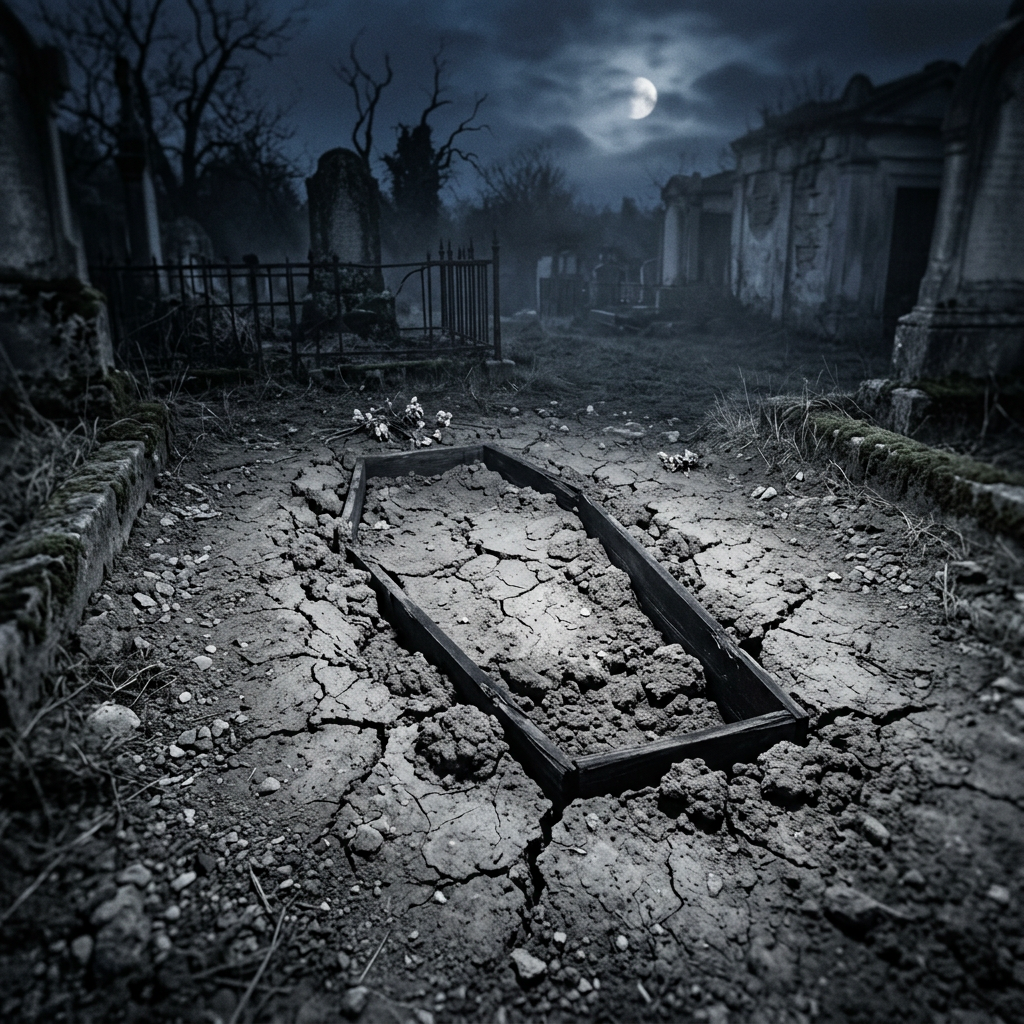
Most churchyards are filled with the quiet dead. Names weathered by rain. Dates softened by lichen. Lives reduced to a few carved words. Yet every now and then, a gravestone demands attention. It suggests unfinished business, of secrets carried into the earth and never fully buried. Such a grave stands in the churchyard of St Lawrence’s Church at Rushton Spencer, Staffordshire, and it belongs to young Thomas Meakin.
At first glance, the stone appears unremarkable. A young man. Dead in 1781 at the age of twenty-one. Another life cut tragically short in an age when death was a familiar visitor. Look closer, however, and oddities begin to emerge. The grave occupies an unusual position. It seems to stand apart from its neighbours. Visitors have long remarked upon its orientation, noting that it does not appear to conform to the traditional arrangement expected within a Christian burial ground. Whether this is genuinely significant or merely a consequence of later reinterment is impossible to say.
Then there is the inscription.Among the words carved into the stone appears a phrase that has puzzled visitors for generations:
‘Bia Thanatos’
Translated from the Greek, it means:
“violent death.”
It is an extraordinary thing to find upon the grave of a Staffordshire stable groom.The inscription is accompanied by words from scripture:
“As a man falleth before wicked men, so fell I.”
And taken together, they read less like a memorial and more like an accusation. Who were these wicked men? What violence had befallen Thomas Meakin? And why did somebody feel compelled to carve these words into stone?
The accepted version of events tells us that Thomas was employed by an apothecary in the town of Stone. According to local tradition, he had fallen in love with his employer’s daughter. Such a match may not have been welcomed by all concerned. Whether the romance genuinely existed or emerged later as part of the legend is impossible to prove, but it remains an enduring part of the story. Then Thomas died. Officially, that should have been the end of the matter. Instead, it was merely the beginning.
The most famous version of the tale claims that Thomas had not died at all. Rather, he had been mistakenly declared dead and buried alive.The story alleges that his grave was later opened and disturbing evidence discovered within the coffin. His body was said to have shifted position. Scratches marked the interior. Signs of a desperate struggle suggested that consciousness had returned to Thomas after burial. It is a story that strikes directly at one of humanity’s oldest fears.
Today such a mistake seems almost impossible. In the eighteenth century it was terrifyingly plausible. Medical science remained imperfect. Conditions such as catalepsy, coma and certain fevers could mimic death with alarming accuracy, as could certain types of poisoning. Throughout Britain and Europe, stories circulated of coffins opened to reveal evidence of movement from within.Whether Thomas Meakin was truly one such victim remains unknown.
Adding further pathos to the tale is the story of his horse. According to local folklore, the animal repeatedly returned to its master’s grave and refused to leave. Villagers saw this as evidence that something was terribly wrong. Fact and folklore became hopelessly intertwined.
What can be stated with confidence is that Thomas Meakin existed. Parish records confirm his death. They also record the subsequent movement of his remains from Stone to Rushton Spencer. Everything beyond that point becomes increasingly uncertain.Yet uncertainty is where folklore thrives.
Over the centuries, additional rumours attached themselves to the story. Some spoke of poisoning. Others whispered of murder. A few even suggested links to secret societies and Masonic rites. According to these darker versions, Thomas had somehow become entangled in matters beyond his understanding. No evidence has ever surfaced to support such claims. Nevertheless, they persist. Perhaps because the gravestone itself encourages speculation – the unusual orientation. The reference to wicked men.The declaration of violent death – Each detail invites questions. Each question demands an answer. And where answers are absent, stories rush in to fill the void.
Standing before the grave today, one is struck not by certainty but by mystery. Two and a half centuries have passed since Thomas Meakin’s death, yet visitors still pause before the stone and wonder. Was he murdered? Was he buried alive? Did he fall victim to a forbidden romance?
Or did later generations weave a tale around an ordinary tragedy until the truth became impossible to separate from legend?
We may never know. What remains is a gravestone, a handful of records, and a tale that refuses to stay buried, and maybe that is why the story of Thomas Meakin still fascinates us today.
Not because we know what happened to him.
But because we don’t.
Further Reading:
Parish records of St Lawrence’s Church, Rushton Spencer
Local histories of Stone and Rushton Spencer
Studies of premature burial in Georgian Britain
Staffordshire folklore collections
Copyright © Kirst Mason D’Raven / Mysterious Times. All rights reserved.

Leave a Reply