The legend of the Yeti is perhaps the most widely known legend from the Himalayan region. The tale is filled with all the ‘good stuff’ – cultural, spiritual, and historical elements.
But… (Switches to Danny Robins’ voice)… What If I told you there was more to this story than just some massive, snowy footprints?
Let’s take a deep dive into the corners of your imagination and suspend your belief for… Na… It’s no good. I’m giggling too much..😂
Here’s a (not A.I, in case you were wondering) round up of snowy supernatural and high altitude high strangeness from the Himalayas – enjoy!
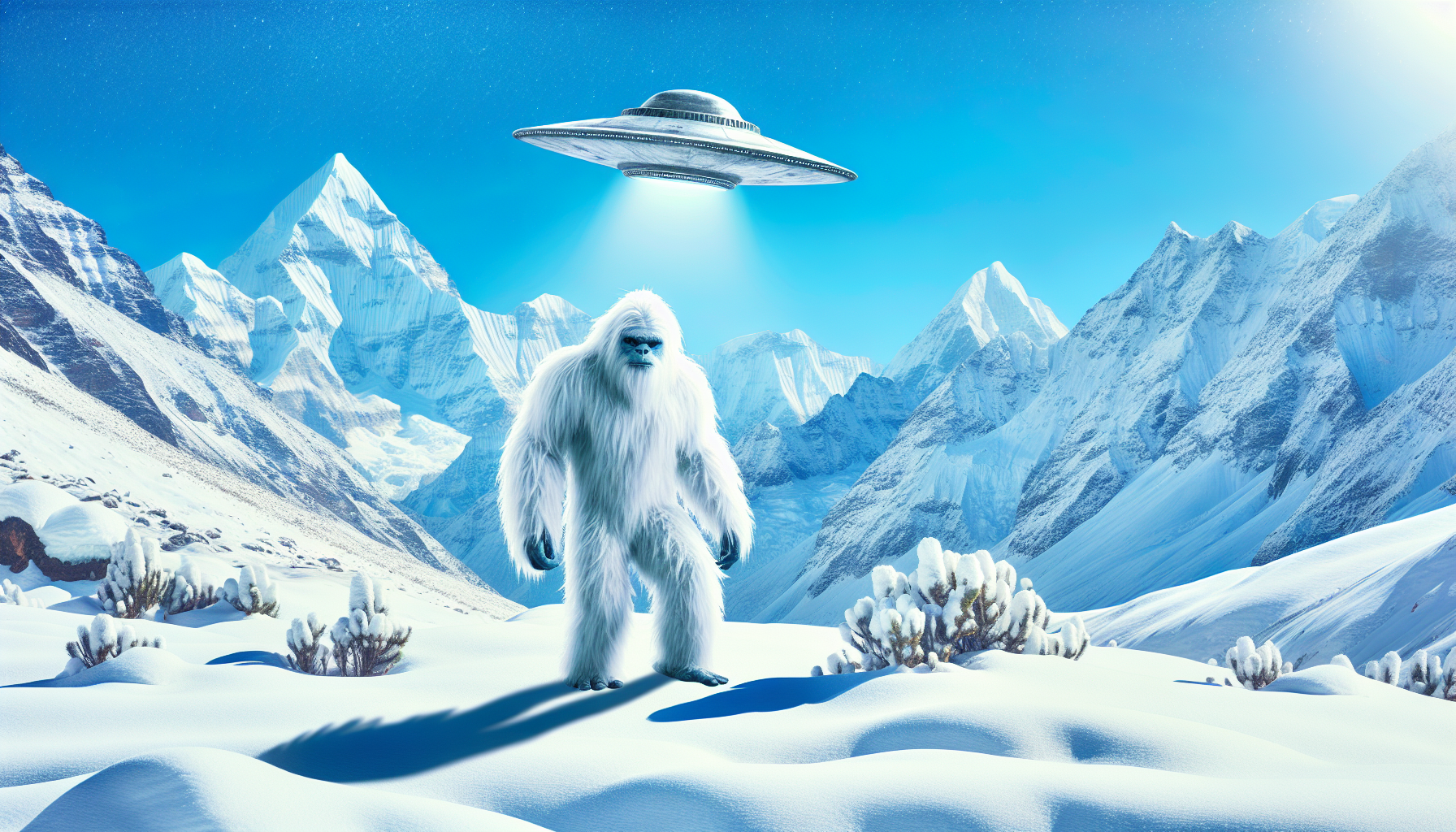
The Yeti, often described as a large, ape-like creature, has various depictions depending on the region. It is typically portrayed as a hairy, human-like figure with a formidable presence, standing between 6 to 10 feet tall. The Yeti’s fur is usually described as white or grayish, blending well with the snowy environment.
The creature’s name and characteristics vary across different Himalayan communities. In Nepal the hairy fella is known as the “Yeti” or “Miche” (wild man).In Tibet he is referred to as “Migo” or “Mi-go,” sometimes described with more supernatural traits than your average snow – biped and in Bhutan they call him “Migo” or “Mirka,” and he is believed to inhabit remote, forested areas.
In many Himalayan cultures, the Yeti is more than just a physical being; it is seen as a spiritual entity with a deep connection to nature. Some local myths suggest the Yeti has the ability to shape-shift or become invisible, emphasizing its mystical nature. The creature is often associated with mountain deities and spirits, serving as a guardian of the natural world.
Monasteries and hermits in the Himalayas have long shared stories of Yeti encounters. These tales often highlight the Yeti’s strength and elusiveness. For example, there are accounts of monks who claim to have seen the Yeti or found its footprints while meditating in remote caves. Or maybe while they were sledging. Who knows what these monks do in their spare time?
Western interest in the Yeti surged in the 19th century as explorers and mountaineers ventured into the Himalayas.
Reports of mysterious footprints and eerie howls added to the intrigue. One significant early report came from British explorer Charles Howard-Bury in 1921, who found large footprints while on an expedition to Mount Everest.
His Sherpa guides attributed these to the “metoh-kangmi,” translated as “man-bear snowman.”
In fairness to Mr Howard- Bury there was no Google translate in those days – they could’ve said anything. Also, Man Bear Snowman might have been their nickname for the local crazy guy who lived in the woods – who knows what Sherpa guides find amusing? I don’t. That’s for sure!
Aaanyway…
The most famous Yeti sighting was by British mountaineer Eric Shipton (I don’t think he was any relation to Harold or Mother) in 1951, who photographed large footprints near Mount Everest.
These photographs sparked widespread speculation and fascination in the West, leading to numerous expeditions aimed at finding the elusive creature.
Many scientists and researchers attribute Yeti sightings to misidentified animals. For instance, the footprints could be from bears, langurs, or yaks distorted by the melting snow. Additionally, the Yeti’s descriptions often overlap with known animals, leading to speculation that it might be an undiscovered species or a mythological interpretation of existing wildlife.
In recent years, scientific efforts to identify the Yeti have included DNA analysis of hair, bones, and other purported Yeti remains.
A notable study published in 2017 analyzed samples from the Himalayas and found them to be from various bear species. I believe I may have written an article on it at the time. Despite these findings, the mystery of the Yeti persists, with some researchers suggesting that the legend may stem from rare encounters with unknown or hybrid species.
The Yeti has become a popular figure in global media, appearing in numerous books, movies, and TV shows. It is often depicted as a mysterious and formidable creature, sometimes benevolent and sometimes menacing. Films like “Monsters, Inc.” and “Smallfoot” portray the Yeti in a more whimsical light, while horror genres depict it as a fearsome beast.
The Yeti legend has also become a significant part of the Himalayan tourism industry. Trekkers and adventurers are drawn to the region by the possibility of encountering the legendary creature and in Nepal, the Yeti is celebrated in festivals and has become a symbol of the country’s rich cultural heritage.
Aside from the hairy, Himalayan honcho the yeti, the Himalayas provide a fertile ground for other myths, legends and paranormal phenomena – The Banjhakri, for example.
The Banjhakri, or “jungle shaman,” is a mystical figure in Nepali and Sikkimese folklore. These beings are described as small, humanoid creatures with backward-turned feet and shamanic abilities. They are believed to abduct young shamans and teach them the art of healing. The Banjhakri is an important figure in the training of traditional healers, known as Jhankris, in the region.
Many Himalayan monasteries, such as Tengboche in Nepal, have stories of guardian deities and spirits. Monks and locals often tell of experiences of supernatural occurrences, including apparitions and unexplained sounds.
Certain areas, like the Roopkund Lake in India, are infamous for their eerie atmosphere and mysterious past. Roopkund, also known as Skeleton Lake, contains hundreds of ancient human skeletons, leading to numerous ghost stories and theories about their origins..
Which leads us nicely into.. Aliens!
There have been sporadic reports of UFO sightings in the Himalayas. Witnesses describe seeing strange lights or objects moving in the sky, often over remote and high-altitude areas where conventional explanations (like aircraft) seem unlikely.
These sightings are often attributed to natural phenomena such as meteorological events, military aircraft, or even the planet Venus being particularly visible in the clear, high-altitude skies.
With the yeti, ghosts, UFO and so many other varied phenomenon reported in and around the Himalayas it seems inevitable that the area would fall like an avalanche into the category of ‘High Strangeness’.
but…
Anyone who knows me would definitely think this article was not written by me if I didn’t at least make a half hearted attempt at offering some more mundane explanations.
I have never been to the Himalayas but I have been investigating and researching the paranormal for many years – decades, in fact.
I have investigated areas of high strangeness – Actually, on site, doing the dirty work, not just sitting behind a keyboard or phone venting my opinion.
I have done onsite investigations for the police, businesses and the media and I have, if you’ll pardon the expression, seen some weird shiz.
The theories I forward here are my attempts at explaining some of the phenomena. My opinions based on my research and experiences in similar fields. I hasten to add that my opinions have never made me rich, famous or popular, but have brought comfort or closure in other circumstances.
The reality is that paranormal phenomena is very rare, if it exists at all, and a multitude of environmental factors can interfere with how we process what our senses perceive.
High altitudes can cause altitude sickness, leading to hallucinations and distorted perceptions. This could explain some of the more extraordinary sightings and experiences reported by climbers and trekkers.
The harsh and variable weather conditions in the Himalayas can create illusions and amplify natural sounds, contributing to reports of paranormal activity. Shadows, rock formations, and footprints can be easily misinterpreted in the snow and ice.
Many Yeti sightings and tracks can be attributed to animals such as the Himalayan brown bear, blue bear, snow leopard, and even large species of birds. Bears, in particular, can leave tracks that resemble human footprints when they step in their own tracks, creating an illusion of a bipedal creature.
So while the reports of phenomena in the Himalayas remain compelling, the lack of firm evidence so far leaves these accounts in the realm of speculation.
As with all arenas of the unexplained, continued exploration and research are necessary to substantiate these claims and separate myth from reality.
Only with rigorous scientific inquiry can we hope to fully understand and appreciate the mysteries that these majestic mountains hold, and due the vastness of the area in question, we probably never will.
And in all honesty, that might not be a bad thing. The world needs to have a few little mysteries so we can keep our sense of wonder.
🙂