Pull up a tree stump, things are about to get… Weird…
Picture this – a dark winter’s night in rural Wales, the scent of damp earth and burning wood in the air, and an eerie sound echoing through the hills.
It’s not the screech of an owl or the howl of a distant wolf. No, it’s the rhythmic clopping of hooves, the jingling of bells, and a low, haunting cry, slowly drawing nearer.
What’s happening?
The Mari Lwyd has come to town.
Now, the Mari Lwyd (pronounced mah-ree looid) is one of those odd, whimsical traditions that make you scratch your head and wonder just how, exactly, a hobby horse with a skull could become such a beloved part of Welsh folklore – but that’s precisely the charm of it.
This strange custom has survived centuries, entertaining and baffling generations in Wales, and while it might sound like something straight out of a medieval fever dream, it’s an experience that brings communities together in a way few other traditions can.
Allow me to set the scene..
Imagine a group of villagers preparing for the winter festivities, perhaps just after Christmas, on the edge of the new year. The sky has long since turned black, the air sharp and biting. But inside the homes, there’s a warm glow. The fire is crackling, the tables laid out with treats – sweets, pies, and cider. But then comes a knock at the door.
It’s not a simple knock, though, it’s a determined, insistent rattle. It’s the unmistakable sound of hooves and bells.
The door creaks open, and there she stands – the Mari Lwyd.
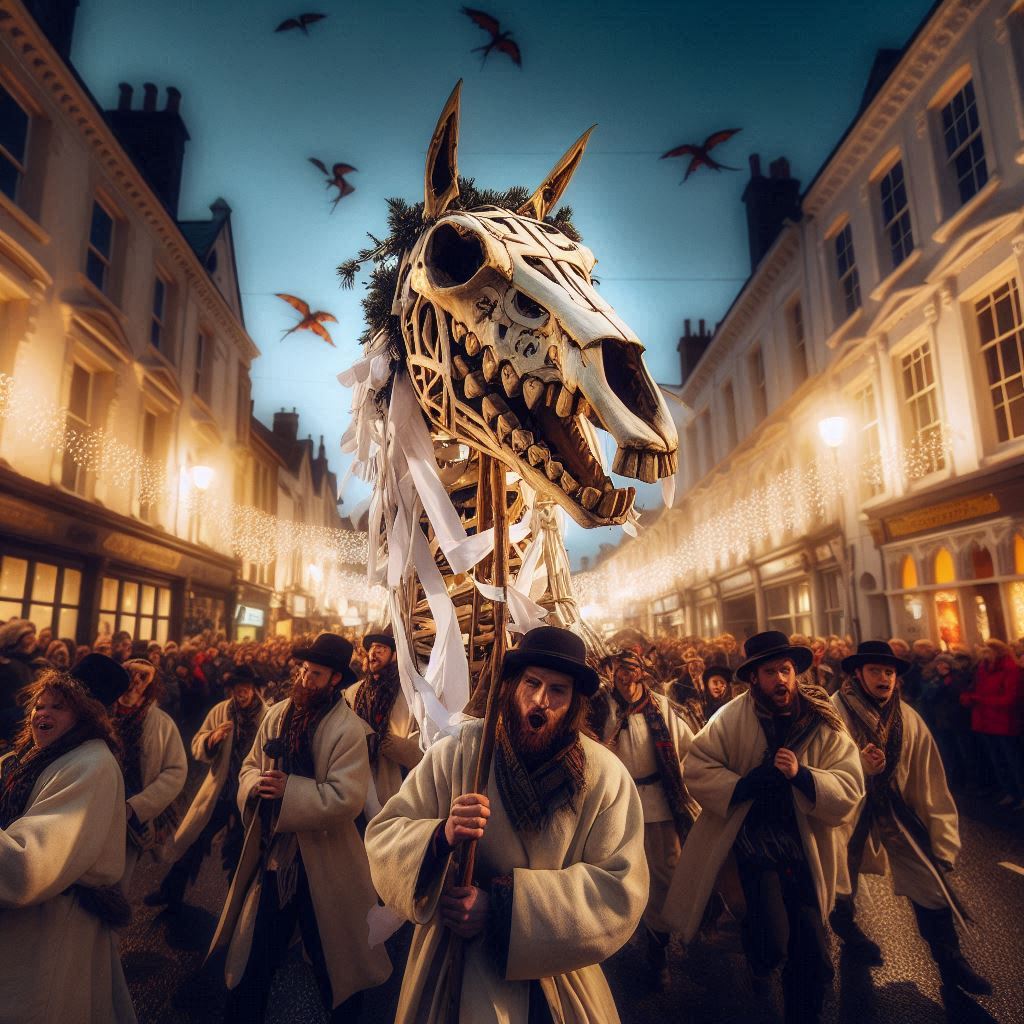
The Mari Lwyd is an ancient folk tradition that involves a person carrying a horse’s skull on a stick, dressed up with a white sheet, and often adorned with ribbons, bells, and other decorations. The skull, mounted on a wooden frame, typically sports glass eyes that gleam eerily in the moonlight, and the whole figure is carried by someone hidden beneath the cloth.
The Mari Lwyd is usually accompanied by a merry band of revelers, sometimes known as the pwnco, who sing and chant as they go from house to house, demanding entry with good-natured but persistent enthusiasm.
The idea is simple: the Mari Lwyd, with her bony face and wild eyes, challenges the people inside to a battle of wits, through a kind of poetic exchange called interludes. In this merry duel, the pwnco will sing or chant a line, and the residents of the house must respond with a clever or witty retort. This back-and-forth continues until either the challengers (the Mari Lwyd and her crew) are granted entry or they are sent on their way.
Of course, a good deal of laughter and a little bit of mischief are involved. The Mari Lwyd is not an ominous figure but a trickster spirit, one who delights in wordplay, fun, and the gentle push and pull of a good-natured contest.
But where does this odd tradition come from?
To trace the roots of the Mari Lwyd, we have to look deep into Welsh history. Some say the tradition dates back as far as the 5th century, tied to ancient Celtic rituals and perhaps the desire to chase away the darker spirits of winter. Others point to its connection to the practice of wassailing – going door to door singing and offering blessings for prosperity and good health. There are also theories that the Mari Lwyd is connected to the death and rebirth of nature itself, with the horse skull symbolizing both the end of the old year and the promise of the new one.
Interestingly, the horse as a symbol in Welsh folklore is often linked with death and the supernatural, which might explain the skeletal appearance of the Mari Lwyd. In a way, she is a creature straddling two worlds, the living and the dead, and her arrival marks a moment of transition. While her appearance might seem macabre to some, the spirit of the tradition is anything but. The Mari Lwyd is not a figure of terror; she’s a figure of life, laughter, and community spirit.
For many years, the custom was largely confined to the rural areas of Wales, with each region putting its own spin on the Mari Lwyd. The tradition, however, started to fade by the mid-20th century, as modern life and other celebrations began to take precedence. But in recent decades, the Mari Lwyd has seen something of a revival.
Communities have rekindled the tradition, embracing its quirky, light-hearted spirit and the sense of togetherness it brings. These days, you might find Mari Lwyd processions in towns and villages across Wales, with participants donning elaborate costumes and performing the poetic exchanges for crowds of amused onlookers.
Despite its revival, the Mari Lwyd is still very much a local event, deeply tied to the specific regions where it thrives. In some places, the Mari Lwyd is only seen on New Year’s Eve, while in others, it can be part of the festivities all through the Christmas season and beyond. And though the Mari Lwyd might be rooted in ancient customs, her appeal today is fresh and lively.
It’s hard not to smile as you watch a group of people laughing their way through a spirited exchange of verses with the horse-skull creature.
One of the more fascinating aspects of the tradition is the way the Mari Lwyd transcends generations. Older participants pass the knowledge of the interludes to the younger ones, and the whole event is a joyous reminder of how traditions, even the strange ones, can bring a community together. It’s a celebration of creativity, wit, and perhaps most importantly, the joy of shared experience. There’s a sense that, no matter how quirky or outlandish the tradition might seem to outsiders, those who participate are doing something timeless, something that connects them to their ancestors in a meaningful and playful way.
And let’s not forget the importance of the horse skull itself. The Mari Lwyd’s appearance is certainly striking, but it’s the way it’s used that creates the magic. The skull is not meant to be creepy or frightening. It’s a playful, imaginative symbol, one that gives the performer a way to embody something both otherworldly and utterly ridiculous. After all, who wouldn’t want to take part in a procession that involves a horse skull and a good deal of public poetry?
In the end, the Mari Lwyd is more than just an odd Welsh custom. It’s a reminder that not all traditions need to be steeped in solemnity. Sometimes, the best traditions are the ones that allow us to laugh at ourselves, to celebrate the quirky, the strange, and the joyful parts of life.
The Mari Lwyd is a tradition that thrives on wit, humour, and, of course, a little bit of theatricality. So, next time you’re in Wales during the winter season, keep an ear out—you might just hear the jingling bells and the distant calls of the Mari Lwyd, leading her merry procession through the crisp, starry night.